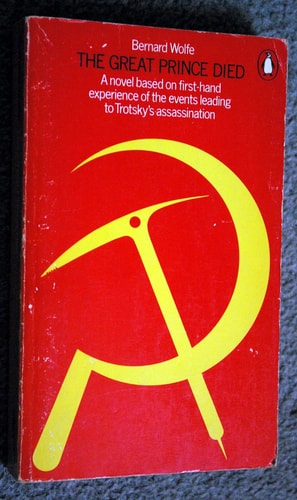
The Great Prince Died
0
0
As an Amazon Associate and affiliate partner, Menrva Books earns from qualifying purchases. Learn more
Author Description
On August 20, 1940, Marxist philosopher, politician, and revolutionary Leon Trotsky was attacked with an ice axe in his home in Coyoacán, Mexico. He died the next day.In The Great Prince Died, Bernard Wolfe offers his lyrical, fictionalized account of Trotsky’s assassination as witnessed through the eyes of an array of the young American student helping to translate the exiled Trotsky’s work (and to guard him), the Mexican police chief, a Rumanian revolutionary, the assassin and his handlers, a poor Mexican “peón,” and Trotsky himself. Drawing on his own experiences working as the exiled Trotsky’s secretary and bodyguard and mixing in digressions on Mexican culture, Stalinist tactics, and Bolshevik history, Wolfe interweaves fantasy and fact, delusion and journalistic reporting to create one of the great political novels of the past century.
Menrva's Summary
THE PULSE
The narrative centers on the final days of Leon Trotsky in Mexico, culminating in his assassination by an ice-axe-wielding operative. The protagonist, an American student serving as a translator and bodyguard, navigates the claustrophobic and paranoid environment of Trotsky’s Coyoacán compound. As the threat of Stalinist agents looms, the student must reconcile his ideological devotion with the reality of the exiled leader’s isolation. The narrative framework utilizes a multi-perspective approach, shifting between the inner circle of the revolutionary, the local authorities, and the assassin himself to build a portrait of political collapse.
INSIDE THE PAGES
- Multi-perspective narrative structure
- Integration of historical fact with fictionalized internal monologues
- Detailed exploration of Stalinist political tactics
- Inclusion of cultural observations regarding mid-century Mexico
- Examination of the psychological state of the assassin
- First-person accounts from the perspective of the bodyguard
- Analysis of the ideological conflicts within the Bolshevik movement
- Stylistic blending of journalistic reporting and subjective narrative
THE COLLECTIVE ECHO
Readers and critics frequently note the dense, intellectual nature of the prose, which reflects the author's own background as a former secretary to Trotsky. Discussion often centers on the effectiveness of the multi-perspective format in capturing the paranoia and ideological rigidity of the era. Many highlight the balance between the historical accuracy of the assassination and the author's speculative exploration of the characters' motivations. The work is often cited for its atmospheric depiction of the political tensions surrounding the exiled revolutionary. Readers appreciate the way the narrative avoids simple hero-worship, opting instead for a complex examination of power and betrayal.
Page Count:
392
Publication Date:
1972-01-01
Publisher:
Penguin Books
ISBN-10:
0140034064
ISBN-13:
9780140034066
Historical Fiction
Literary Fiction
Espionage
Biographical fiction
Political fiction