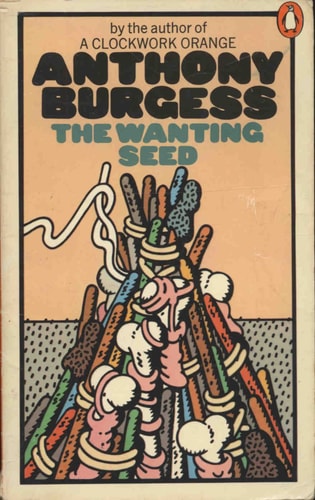
The Wanting Seed
0
0
As an Amazon Associate and affiliate partner, Menrva Books earns from qualifying purchases. Learn more
Author Description
The Wanting Seed could be described as a Malthusian comedy, for its underlying theme is the problem the whole world may soon have to face--over-population--and its technique is fantasy and caricature. The setting is England (one of the chief members of Enspun or the English-Speaking Union) and the time is less the future than a sort of extension of the present.The story is concerned with the vicissitudes of Tristram Foxe and his wife Beatrice-Joanna in their skyscraper world of spacelessness where official family limitation glorifies homosexuality (" It's Sapiens to be Homo ") and which is eventually transformed into a chaos of cannibalistic dining-clubs, fantastic fertility rituals, and wars without anger. It is a novel both extravagantly funny and grimly serious.
Menrva's Summary
THE PULSE
In a future England grappling with extreme overpopulation, the government enforces strict anti-natalist policies that force citizens to navigate a society where homosexuality is state-sanctioned and traditional family structures are criminalized. Tristram Foxe and his wife, Beatrice-Joanna, struggle to maintain their personal autonomy within a rigid, claustrophobic urban environment that prioritizes population control above all else. As the state’s grip on social norms fluctuates, the couple is swept into a volatile cycle of societal collapse, shifting from enforced sterility to chaotic, ritualistic fertility. The narrative employs a satirical framework to examine the cyclical nature of human history and the absurdity of state-mandated social engineering.
INSIDE THE PAGES
- Satirical exploration of Malthusian population theories
- Use of caricature to depict government bureaucracy
- Non-linear progression of societal collapse
- Integration of literary allusions and quotations
- Exploration of cyclical historical patterns
- Vivid, often grotesque, descriptions of urban decay
- Linguistic playfulness and rich vocabulary
- Surreal dream and nightmare sequences
THE COLLECTIVE ECHO
Readers and critics frequently highlight the novel's blend of dark humor and grim social commentary, noting how it functions as a biting critique of state control. Discussion often centers on the author's inventive use of language and his ability to construct a world that feels like a distorted reflection of contemporary societal anxieties. Many observers point to the shift from a sterile, regulated society to one of chaotic, primitive violence as a central point of thematic interest. The work is often praised for its intellectual depth and its refusal to offer easy solutions to the complex problems it presents. Readers generally find the narrative pacing to be intense, reflecting the erratic and unpredictable nature of the world the characters inhabit.
Page Count:
224
Publication Date:
1973-01-01
Publisher:
Penguin, Harmondsworth
ISBN-10:
0140035524
ISBN-13:
9780140035520
Dystopian
Science Fiction
Satire
Political fiction
Speculative Fiction
Community Tags
Similar Books