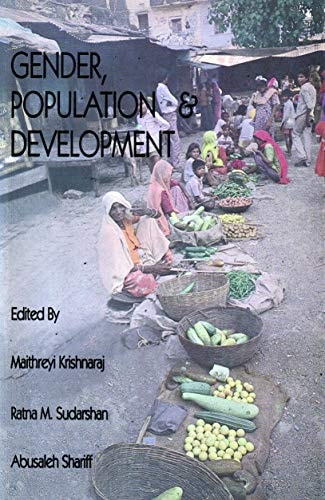
Gender, Population and Development
0
0
As an Amazon Associate and affiliate partner, Menrva Books earns from qualifying purchases. Learn more
Author Description
Product Description One million women are "missing" from India's population due to female neglect of various sorts--and possibly one million more due to acts of direct elimination before birth. Within that context, this collection employs several field surveys to explore the connections between population,gender, and development by way of two distinct sets of conditions. The first set involves individual endowments--the resources that a household will allocate to its women. The second set concerns the ways in which the productive and reproductive roles of men and women are structured in societies.With the help of theoretical reviews and empirical studies, this book illustrates the powerful, intermediary effects of gender relations in modifying or reinforcing gender biases. Review `The volume is impressive for the new body of evidence it has brought together on gender bias inIndia, and for providing some new theoretical insights.' The Book Review Vol XXII No 1+2 Jan & Feb About the Author Maithreyi Krishnaraj is on the Indian Council for Social Science Research. Ratna Sudershan and Abusaleh Shariff are both at the National Council of Applied Economic Research, New Delhi.
Menrva's Summary
THE THESIS
This volume investigates the systemic factors contributing to gender-based population disparities in India and the role of gender relations in shaping development outcomes. The authors, affiliated with the Indian Council for Social Science Research and the National Council of Applied Economic Research, synthesize theoretical frameworks with empirical field survey data. They argue that individual household resource allocation and the societal structuring of productive and reproductive roles act as primary drivers for gender bias.
THE SCOPE MAP
What You Will Find
- Analysis of female neglect and direct elimination practices within the Indian population.
- Examination of household resource allocation models regarding women.
- Empirical data derived from field surveys conducted in India.
- Theoretical review of how gender relations modify or reinforce existing biases.
THE AUTHORITY PERSPECTIVE
Experts and reviewers recognize this volume as a significant contribution to the empirical study of gender bias in India. The text is noted for its ability to bridge theoretical insights with a substantial new body of evidence, making it a valuable resource for researchers in development studies.
Page Count:
380
Publication Date:
1998-08-27
Publisher:
Oxford University Press
ISBN-10:
0195642341
ISBN-13:
9780195642346
Demography
Sociology
India
Gender Studies
Community Tags
Similar Books