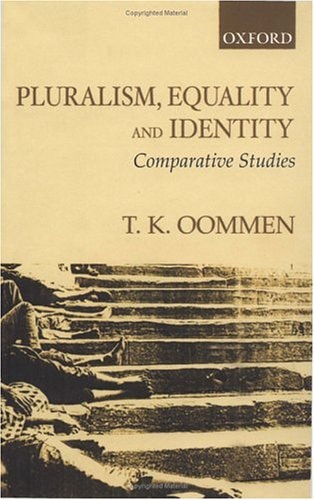
Pluralism, Equality and Identity: Comparative Studies
0
0
As an Amazon Associate and affiliate partner, Menrva Books earns from qualifying purchases. Learn more
Author Description
The essays in this book are based on the premise that the notions of pluralism, equality and identity are inextricably intertwined and inorder to be translated into practice, should be operationally interlinked. Drawing illustrations and empirical data from different societies, the author concludes that while western liberal theory emphasizes equality, it ignores pluralism and identity based on the mistaken assumption that nation-states are becoming homogenized.
Menrva's Summary
THE THESIS
This work investigates the complex interplay between pluralism, equality, and identity, arguing that these concepts must be operationally interlinked to be effectively realized in modern society. T. K. Oommen, a professor of sociology at Jawaharlal Nehru University, utilizes a comparative sociological framework to critique western liberal theory. He contends that western models often prioritize equality while neglecting the essential roles of pluralism and identity, erroneously assuming that nation-states are trending toward homogenization.
THE SCOPE MAP
What You Will Find
- Comparative analysis of pluralism, equality, and identity across diverse global societies.
- A critique of western liberal theory regarding the homogenization of nation-states.
- Empirical data and case studies illustrating the practical application of social theories.
- Theoretical frameworks for integrating identity-based concerns into political and social policy.
THE AUTHORITY PERSPECTIVE
Scholars and students of sociology frequently cite this text for its rigorous comparative approach to identity politics and state formation. Experts highlight the book as a significant contribution to the discourse on how liberal democracies must adapt to accommodate pluralistic social structures.
Page Count:
189
Publication Date:
2002-03-28
Publisher:
Oxford University Press
ISBN-10:
0195657764
ISBN-13:
9780195657760
Sociology
Identity politics
Comparative Studies
Identity Philosophical concept
Social Theory
Comparative Government
Community Tags
Similar Books