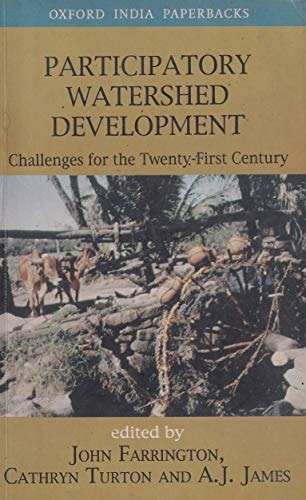
Participatory Watershed Development
0
0
As an Amazon Associate and affiliate partner, Menrva Books earns from qualifying purchases. Learn more
Author Description
Efforts have long been made in India to improve the management of major watersheds for ecological reasons - such as reducing the siltation of reservoirs. The management of micro-watersheds (of around 500 hectares) is a more recent focus of policy and has both ecology and livelihoods as its objectives. Experiments have shown that, in some areas, more than a doubling of resource productivity can be achieved by careful rehabilitation. Many watersheds contain both private and common land. It is already clear from a number of efforts led by NGOs that, to be equitable and institutionally sustainable, the rehabilitation of both common and private lands needs action rooted in strong resource user-groups capable of taking decisions in a participatory way and resolving conflict. To build up groups in this way requires both time and skills, both of which have proved elusive in government projects and programmes. The key question addressed in this book is how far the approaches developed by NGOs can be adopted (or adapted) by the public sector and applied on a wide scale, for, without such approaches, neither the ecological nor the livelihood benefits of watershed rehabilitation will be achieved.
Menrva's Summary
THE THESIS
This book investigates the extent to which participatory, NGO-led approaches to micro-watershed management can be effectively scaled and adopted by the public sector to improve ecological and livelihood outcomes. The authors, drawing on extensive research and field experiments in India, analyze the institutional challenges inherent in transitioning from top-down government projects to community-based resource management. They argue that the success of watershed rehabilitation depends on the formation of robust, autonomous user-groups capable of equitable decision-making and conflict resolution.
THE SCOPE MAP
What You Will Find
- Analysis of micro-watershed management policies covering approximately 500-hectare units.
- Evaluation of the institutional requirements for building sustainable resource user-groups.
- Comparative study of NGO-led initiatives versus government-led development programs.
- Assessment of the socio-economic and ecological impacts of land rehabilitation on private and common lands.
THE AUTHORITY PERSPECTIVE
Experts recognize this work as a critical examination of the limitations of state-led development in the Indian context. Readers frequently note the academic density of the prose and its value as a foundational text for policy practitioners and development researchers.
Page Count:
368
Publication Date:
2001-01-01
Publisher:
OUP India
ISBN-10:
0195655443
ISBN-13:
9780195655445
India
Public Policy
Sustainability
Agriculture
Natural Resources
Community Tags
Similar Books