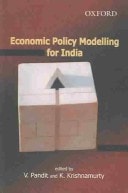
Economic Policy Modelling for India
0
0
As an Amazon Associate and affiliate partner, Menrva Books earns from qualifying purchases. Learn more
Author Description
This volume applies modern quantitative techniques to the meaningful analysis of economic policy, economic forecasting, and scientific quantification of economic relationships. The essays deal with issues in policy modelling for the Indian economy with respect to: price behaviour, growth scenarios, monetary policy, business cycles, debt management, exchange rate and trade flows, and consumption behaviour. In highlighting effective macroeconomic modelling techniques from apolicy perspective, the volume enables convergence between professional economists and policy-formulators. This ensures meaningful application of econometric methodology to a spectrum of policy themes resulting in more reliable effective, and sustainable solutions. The principal economy-wide modelling techniques the volume focuses on include: structural modelling, spectral analysis, optimal control, coincident indicators, and the latest extension of almost ideal demand systems (AIDS). Presenting an overview of the developments in the field of structuralmacroeconometric modelling in India in the last two decades, the contributors encapsulate the diverse methodologies used as well as the empirical results generated. This book is of contemporary relevance to the new policy regime geared for globalization. It firmly sends out the message that in an era of increasingly dynamic market structures, it is necessary to quantify behavioural patterns and adjustment processes rather than relying on rules of thumb andcasual empiricism. Contributors include Nobel Laureate Lawrence Klein, Jan Tinbergen, D M Nachane, and winner of the Mahalanobis Memorial National Award M J Manohar Rao, among others.
Menrva's Summary
THE THESIS
This volume investigates the application of modern quantitative and econometric techniques to address complex policy challenges within the Indian economic landscape. Author Kuruganti Krishnamurty, alongside a distinguished group of contributors including Nobel Laureates, presents a framework for moving beyond casual empiricism toward rigorous, data-driven policy formulation. The text synthesizes two decades of structural macroeconometric developments to provide a bridge between academic economic theory and the practical requirements of government policy-making.
THE SCOPE MAP
What You Will Find
- Analysis of price behavior, growth scenarios, monetary policy, and business cycles.
- Methodologies including structural modelling, spectral analysis, optimal control, and almost ideal demand systems (AIDS).
- Empirical studies on debt management, exchange rate dynamics, and trade flows.
- A comprehensive overview of macroeconometric evolution in the context of India's globalization.
THE AUTHORITY PERSPECTIVE
Experts and professional economists recognize this volume as a significant reference for understanding the evolution of structural modelling in the Indian context. Readers frequently note the technical density of the prose, which serves as a specialized resource for policy-formulators and advanced students of econometrics.
Page Count:
280
Publication Date:
2004-05-13
Publisher:
Oxford University Press
ISBN-10:
0195666151
ISBN-13:
9780195666151
Economics
Econometrics
India
Macroeconomics
Public Policy
Community Tags
Similar Books