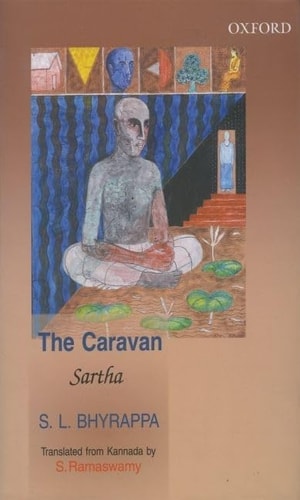
Sartha: The Caravan
0
0
As an Amazon Associate and affiliate partner, Menrva Books earns from qualifying purchases. Learn more
Author Description
Sartha literally means a trading caravan. In ancient India, such caravans would travel to distant lands to trade with them. Sartha is a remarkable novel, which works simultaneously on two planes. It is a physical journey across India, as well as a spiritual inward journey of an eighth-century scholar born to a tradition of Vedic studies.Nagabhatta, the scholar, is deputed by Amaruka, the king, to study the secrets of caravans of other lands in order to improve the economy of his kingdom. During his extensive travels, Nagabhatta becomes a witness to and comes under the influence of dozens of religious, social, and cultural modes. Unusual experiences and peoples are depicted in a historically changing time in the history of India. The novel is a result of a deep and extensive study of history and research conducted at actual locales, like Nalanda. It searches, creatively, the roots of conflicting religious beliefs which India is constantly facing.Bhyrappa is well known for his profound study of philosophical questions. In Sartha, he goes back in time to recreate the atmosphere of a bygone era with an authenticity that is his hallmark. Through this gripping narrative, a vast panorama of the past unfolds before us. It is a novel that abounds in details of eighth-century India, creating an experience that is rich and strange--strange to readers uninitiated into the wealth and diversity of the India of more than a thousand years ago.Sartha can be discussed at several levels. It is a historical novel par excellence, defying western critics' opinion that Indian fiction lacks historical sense. On another level, it is a Picaresque novel, in so far as it concerns itself with the escapades of the protagonist. On yet another plane it is a metaphysical novel, dealing with the philosophy of Advaitic thought. Finally, it is a romance, a very readable story about the true love of Nagabhatta and Chandrika.
Menrva's Summary
THE PULSE
Nagabhatta, an eighth-century Vedic scholar, embarks on a physical and spiritual odyssey across India to uncover the economic secrets of foreign trade caravans for his king. Tasked with this mission by King Amaruka, Nagabhatta encounters a diverse array of social, religious, and cultural landscapes that challenge his traditional upbringing. The narrative follows his movement through a changing historical landscape, forcing him to reconcile his scholarly roots with the realities of a vast and shifting subcontinent. The story unfolds through a third-person perspective that balances the external demands of the caravan with the internal evolution of the protagonist's belief systems.
INSIDE THE PAGES
- Detailed depiction of eighth-century Indian geography and trade routes
- Exploration of Advaitic philosophical thought and Vedic traditions
- Picaresque narrative structure following the protagonist's various encounters
- Integration of historical research conducted at sites like Nalanda
- Romantic subplot involving the protagonist and Chandrika
- Examination of conflicting religious and social ideologies
- Atmospheric recreation of ancient Indian societal norms
- Multi-layered narrative focusing on both physical and metaphysical growth
THE COLLECTIVE ECHO
Readers frequently highlight the novel's success in challenging the notion that Indian fiction lacks a strong historical sense. Discussion often centers on the balance between the meticulous historical detail and the deeper philosophical inquiries that drive the protagonist's development. Critics appreciate the author's ability to weave complex metaphysical themes into a readable narrative that functions as both a travelogue and a character study. The atmosphere is often described as immersive, providing a window into a bygone era that remains relevant to contemporary debates regarding religious and cultural identity in India. Readers often note that the interplay between the external journey and the internal spiritual search creates a unique reading experience that rewards careful attention to the text's philosophical underpinnings.
Page Count:
336
Publication Date:
2006-02-09
Publisher:
Oxford University Press
ISBN-10:
0195676017
ISBN-13:
9780195676013
Adventure
India
Historical
Indian
Philosophical
Picaresque
Community Tags
Similar Books