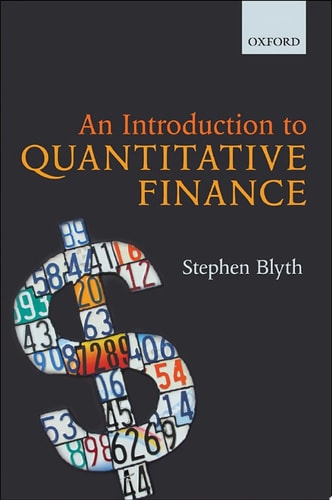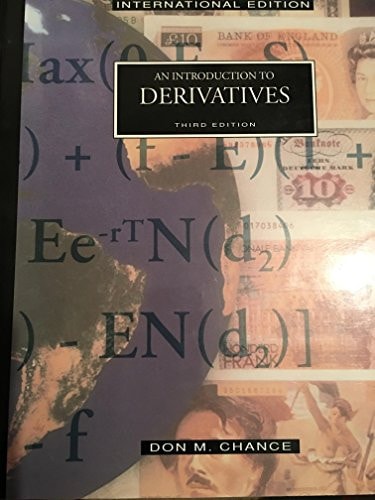
Derivatives: Valuation and Risk Management
0
0
As an Amazon Associate and affiliate partner, Menrva Books earns from qualifying purchases. Learn more
Author Description
Aimed at providing an understanding of the subject, this text presents a clear and rigorous exposition of key theoretical concepts using logic, mathematics, and illustrations. With examples and cases, it demonstrates the applicability of microeconomic tools in the Indian context. A detailed coverage of topics in standard microeconomic texts is accompanied by a focus on recent developments including Application of new tools: game theory concepts New theories: contractual theories of the firm, asymmetric information Examples of topical interest: trading permits in pollution, industrial securities in India Relevant real-life applications: saving and borrowing decisions, efficiency wages, insurance, exhaustible resources, trade union bargaining, etc. Key features and classroom aids in the second edition include New and current topics--opportunity cost of capital, effects of levying different types of taxes, taxation of a monopolist, free trade and tariffs, and learning by doing Tractable functional forms to illustrate the working of the models Updation and expansion of core sections in the text both in terms of theory and data Up to date examples, both applied and numerical, in contemporary Indian context New exercises This comprehensive textbook will appeal to teachers and students in economics. Some of the advanced topics discussed in the book can be used as supplementary material at the postgraduate level. Students in management institutes, the IITs, and other engineering institutes who have to take compulsory courses in microeconomics will find this book especially useful.
Menrva's Summary
THE THESIS
This text investigates the complex mechanisms of financial derivatives, focusing on the mathematical rigor required for accurate valuation and the strategic frameworks necessary for effective risk management. The authors, David A. Dubofsky and Thomas Miller, synthesize quantitative finance principles with practical market applications. By integrating theoretical models with real-world financial data, the book provides a structured approach to understanding how derivatives function within broader capital markets. The work serves as a comprehensive guide for navigating the volatility and pricing structures inherent in modern financial instruments.
THE SCOPE MAP
What You Will Find
- Quantitative models for the valuation of options, futures, and swaps
- Risk management strategies including hedging, arbitrage, and speculation
- Mathematical derivations of pricing formulas such as Black-Scholes
- Case studies illustrating the application of derivatives in corporate finance
THE AUTHORITY PERSPECTIVE
Experts frequently cite this work as a standard academic resource for students and practitioners seeking a technical foundation in financial engineering. Readers often note the high level of mathematical density, which requires a strong background in calculus and statistics to fully grasp the presented concepts.
Page Count:
672
Publication Date:
2012-11-20
Publisher:
Oxford University Press
ISBN-10:
0195686152
ISBN-13:
9780195686159
Economics
Derivatives
textbook
Insurance
Finance
Community Tags
Similar Books