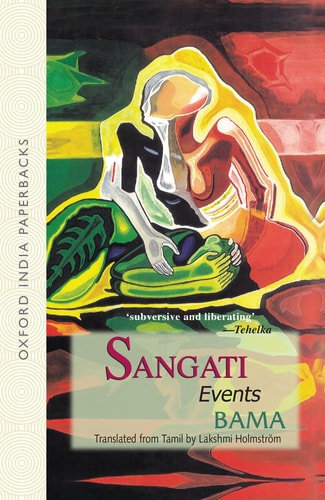
Sangati: Events
0
0
As an Amazon Associate and affiliate partner, Menrva Books earns from qualifying purchases. Learn more
Author Description
Sangati is a startling insight into the lives of Dalit women who face the double disadvantage of caste and gender discrimination. Written in a colloquial style, the original Tamil version overturns the decorum and aesthetics of upper-caste, upper-class Tamil literature and culture and, in turn, projects a positive cultural identity for Dalits in general and for Dalit women in particular.Sangati flouts received notions about what a novel should be and has no plot in the normal sense. It relates the mindscape of a Dalit woman who steps out of her small town community, only to enter a caste-ridden and hierarchical society, which constantly questions her caste status. Realizing that leaving her community is no escape, she has to come to terms with her identity as an educated, economically independent woman who chooses to live alone. In relating this tale, Bama turns Sangati into the story not just of one individual, but of a pariah community.
Menrva's Summary
THE PULSE
The central conflict arises from the protagonist's struggle to reconcile her individual identity as an educated, independent woman with the systemic oppression of caste and gender discrimination inherent in her society. The narrative follows a Dalit woman who attempts to transcend the limitations of her small-town community, only to find that the broader world remains deeply hierarchical and hostile to her status. Through a non-linear, episodic structure, the text explores the physical and social constraints imposed by caste, forcing the protagonist to confront the reality that her education does not grant her immunity from prejudice. The story functions as a collective portrait, shifting focus from a single life to the broader experiences of the pariah community.
INSIDE THE PAGES
- Episodic, non-linear narrative structure that rejects traditional plot conventions
- Use of colloquial Tamil language to challenge established literary aesthetics
- Exploration of the intersectionality between caste and gender discrimination
- Focus on the collective identity of Dalit women rather than a singular protagonist
- Critical examination of social hierarchies and the limitations of upward mobility
- Depiction of the internal mindscape of a woman navigating independent living
- Subversion of traditional upper-caste literary norms and decorum
- Emphasis on cultural resilience and the assertion of a positive Dalit identity
THE COLLECTIVE ECHO
Community and critical discussion often center on the author's deliberate rejection of conventional novelistic structures in favor of a more authentic, community-focused narrative. Readers frequently highlight the raw, colloquial prose style as a primary mechanism for conveying the lived reality of Dalit women. Critics observe that the work effectively balances personal reflection with a broader sociological critique of caste-ridden society. The text is widely recognized for its contribution to subaltern literature and its role in challenging dominant cultural narratives. Discussions frequently emphasize the book's success in transforming individual experience into a powerful collective voice.
Page Count:
152
Publication Date:
2009-04-15
Publisher:
Oxford University Press
ISBN-10:
0195698436
ISBN-13:
9780195698435
Contemporary
Fiction
India
Social Commentary
Community Tags
Similar Books