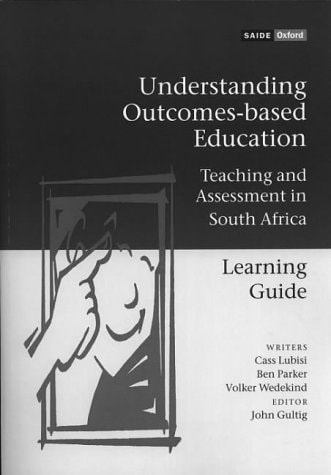
Understanding Outcomes-based Education: Teaching and Assessment in South Africa: Learning Guide
0
0
Author Description
This series of mixed-media learning packages explores the implications of an outcomes- or competence-based educational philosophy for the practice of learning and teaching in South Africa. The series is a dramatic departure from the often didactic and alienating educational texts produced in the past. Each module develops - through case-studies, school-based dialogues, and common educational problems - teachers' abilities to think and solve problems in the fluid educational environment in which they find themselves. Creating People-centred Schools: School Organization and Change in South Africa This module gives teachers a basic understanding of the organizational dynamics of schools, and how they operate within schools to change them. It explores concepts like 'whole school' development, schools as 'learning organizations', and co-operative governance. Understanding Outcomes-based Education: Teaching and Assessment in South African Schools. What does an 'outcomes-based' education paradigm mean for curriculum and assessment practices? What are the knowledge assumptions that underpin OBE? This module explores the differences between 'atomistic' and 'holistic' forms of competence and OBE, especially in relation to curriculum-design and assessment practices.
Menrva's Summary
THE THESIS
This text investigates the practical implications and theoretical foundations of outcomes-based education (OBE) within the specific context of the South African school system. The authors, affiliated with the South African Institute for Distance Education (SAIDE), utilize a modular, problem-solving framework to guide educators through the shift from traditional didactic instruction to competence-based models. By analyzing the knowledge assumptions behind OBE, the text provides a structured approach for teachers to navigate curriculum design and assessment in a rapidly changing educational landscape.
THE SCOPE MAP
What You Will Find
- Comparative analysis of atomistic versus holistic forms of competence in curriculum design.
- Methodologies for implementing outcomes-based assessment practices in classroom settings.
- Case studies and school-based dialogues illustrating common educational challenges.
- Theoretical exploration of the knowledge assumptions underpinning OBE paradigms.
THE AUTHORITY PERSPECTIVE
Experts identify this module as a foundational resource for South African educators transitioning to post-apartheid curriculum standards. Readers frequently note the practical utility of the case-study approach in bridging the gap between abstract educational theory and daily classroom management.
Page Count:
144
Publication Date:
1999-01-01
Publisher:
Oxford University Press Southern Africa
ISBN-10:
0195711602
ISBN-13:
9780195711608
Education
Teaching Methods
Reference
Assessment
South Africa
Educational Philosophy
Community Tags
Similar Books