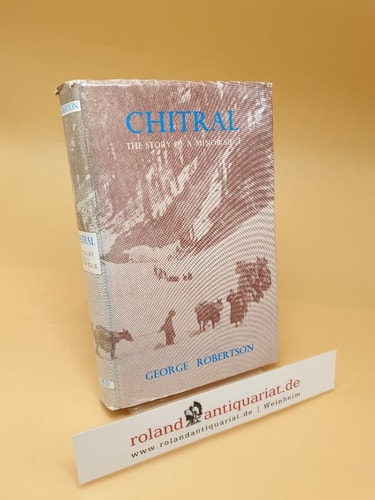
Chitral: The Story of a Minor Siege
0
0
As an Amazon Associate and affiliate partner, Menrva Books earns from qualifying purchases. Learn more
Author Description
Chitral is a remote but strategically placed valley 250 miles long, high in the Hindu Kush Mountains. It had been ruled for many years by Mehtar Aman-ul-Mulk, a man with many wives and children until Aman-ul-Mulk died suddenly on 30 August 1892 at age 71. Thirteen of his many sons were considered eligible to claim the right to rule. His sons started killing each other and four of his sons briefly held power before being killed. In 1895, in the middle of this turmoil, a British military delegation arrived in Chitral headed by Surgeon-Major George Scott Robertson. Robertson had been appointed as political agent by the British as a result of his previous visit to Chitral in 1893 and to adjoining Kafirstan and because of his service in the Second Afghan War from 1878 to 1880. Two other groups representing different claimants for the right to rule arrived in Chitral shortly thereafter. The result was that the Robertson Group took control of the Chitral Fort but were placed under siege by the outside groups. Upon learning that one of their commanders was being held under siege or as a hostage, the British met in Calcutta and resolved to break the siege by military force. The British explorer, adventurer and army officer George Scott Robertson was on his second visit to Chitral. His group had been taken hostage and held under siege. This made it necessary for the British to launch a rescue mission. One military group advanced up from Peshawar, through Mardan, Swat and Dir, crossing Lowari Top and reaching the Chitral Fort where Robertson and his group were being held. The British brought with them Gurkhas, who are fierce fighters from Nepal who did most of the fighting. A second group advanced from a different direction, coming up through Gilgit and Gupis, crossing Shandur Top, reaching Mastuj and advancing down the Chitral River to reach Chitral Fort. In so doing, the two groups inadvertently conquered Chitral and all of the places in between, including Swat, Dir and Gupi
Menrva's Summary
THE THESIS
This work investigates the strategic and political complexities of the 1895 Siege of Chitral and the subsequent British military intervention in the Hindu Kush region. George Scott Robertson, a British political agent and veteran of the Second Afghan War, provides a firsthand account of the internal power struggles following the death of Mehtar Aman-ul-Mulk. The text utilizes Robertson's personal observations and military records to document the collapse of local governance and the resulting British campaign to secure their political interests through force.
THE SCOPE MAP
What You Will Find
- Detailed account of the 1895 Siege of Chitral and the internal succession crisis of the local ruling family.
- Analysis of British colonial military logistics, including the movement of troops through the Hindu Kush mountains.
- Primary source documentation of the political climate in the region during the late 19th century.
- Examination of the roles played by various military units, including the Gurkhas, in the relief of the fort.
THE AUTHORITY PERSPECTIVE
Historians and scholars of colonial military history frequently cite this work as a primary source for understanding British administrative and military operations in the Hindu Kush. Readers often note the dense, detailed prose that reflects the author's background as a political agent and military officer.
Page Count:
368
Publication Date:
1977-01-01
Publisher:
Oxford University Press
ISBN-10:
0195772482
ISBN-13:
9780195772487
Biography
History
Chitral
Asia
Military History
Colonial History
Community Tags
Other Editions(2)

Similar Books

Reader Comments
Share Your Thoughts
No comments yet. Be the first to share your thoughts!