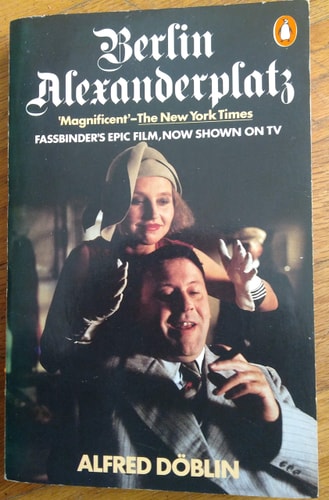
Berlin Alexanderplatz: The Story of Franz Biberkopf
0
0
As an Amazon Associate and affiliate partner, Menrva Books earns from qualifying purchases. Learn more
Author Description
Berlin Alexanderplatz is one of the masterpieces of modern European literature and the first German novel to adopt the technique of James Joyce. It tells the story of Franz Biberkopf, who, on being released from prison, is confronted with the poverty, unemployment, crime and burgeoning Nazism of 1920s Germany. As Franz struggles to survive in this world, fate teases him with a little pleasure before cruelly turning on him. Foreword by Alexander Stephan. Translated by Eugene Jolas.Alfred Doblin (1878-1957) studied medicine in Berlin and specialized in the treatment of nervous diseases. Along with his experiences as a psychiatrist in the workers' quarter of Berlin, his writing was inspired by the work of Holderlin, Schopenhauer and Nietzsche and was first published in the literary magazine, Der Sturm. Associated with the Expressionist literary movement in Germany, he is now recognized as one of the most important modern European novelists.
Menrva's Summary
THE PULSE
Franz Biberkopf, a man recently released from prison, attempts to lead an honest life in the volatile environment of 1920s Berlin, only to be pulled back into the city's criminal underworld. Biberkopf seeks redemption and stability, but he faces relentless pressure from economic hardship, systemic unemployment, and the encroaching influence of political extremism. The narrative follows his interactions with various figures in the city's underbelly, testing his resolve against a backdrop of urban decay. The story utilizes a complex, non-linear framework that mirrors the chaotic atmosphere of the Weimar Republic. Biberkopf's struggle is defined by his desire for moral integrity in a society that offers few opportunities for those with a criminal past.
INSIDE THE PAGES
- Stream of consciousness narrative technique
- Integration of newspaper headlines and advertisements
- Montage-style prose structure
- Urban setting as a central character
- Exploration of moral ambiguity and fate
- Influence of Expressionist literary aesthetics
- Multi-layered linguistic registers
- Psychological depth regarding trauma and rehabilitation
THE COLLECTIVE ECHO
Readers and critics frequently identify this work as a foundational text of European modernism due to its innovative structural techniques. Discussion often centers on the author's ability to capture the frenetic, overwhelming energy of Berlin through a collage of voices and media. Many observers highlight the effectiveness of the protagonist's internal monologue in illustrating the tension between individual agency and societal collapse. The narrative pacing is often described as dense and demanding, requiring significant engagement from the reader to navigate the shifting perspectives. Scholars continue to analyze the text for its historical representation of the political instability that preceded the rise of Nazism in Germany.
Page Count:
480
Publication Date:
1978-01-01
Publisher:
Penguin, Hammondsworth, UK
ISBN-10:
0140045023
ISBN-13:
9780140045024
British & Irish
Social Realism
Expressionist
Historical
Urban
Modernist
German
Community Tags
Similar Books