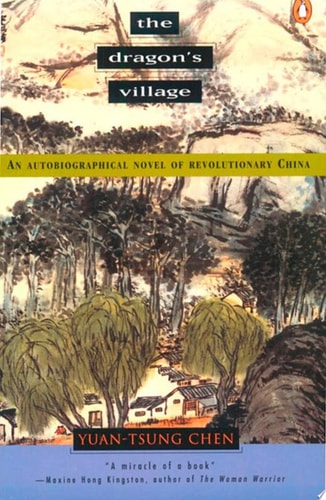
The Dragon's Village: An Autobiographical Novel of Revolutionary China
0
0
As an Amazon Associate and affiliate partner, Menrva Books earns from qualifying purchases. Learn more
Author Description
This extraordinary autobiographical story, compelling, candid, and deeply personal, plunges us into that tumultuous moment in China out of which the modern People’s Republic finally emerged. It is the first time a novelist has ever described that distant world in words that open it up to Western readers in the clearest, most vivid terms.Shanghai, 1949: we look through the eyes of Guan Ling-ling, a headstrong, idealistic seventeen-year-old. As her family departs for Hong Kong, Ling-ling boldly chooses to stay, and joins a revolutionary theater group which soon leaves the city to carry out the new reforms in the Chinese countryside. After a scant few weeks’ preparation, this city-bred schoolgirl suddenly finds herself in one of China’s most remote and impoverished areas, a world so far from her own experience that she can barely understand the lives she has been sent to change.On her very first night in Longxiang (“the Dragon’s Village”), a dusty hamlet far in the northwest, Ling-ling’s life is threatened by agents of a defiant landlord. From that moment on, an unrelenting flood of events engulfs her: plot and counterplot, acts of violence, midnight raids, dramatic personal revelations, even glimmers of first love, all set against a canvas of revolutionary upheaval.Chen carries us on an incredible voyage against China at a critical moment in modern history. No novelist has focused so clearly or so closely on the faces of revolution, or on the physical and social landscapes in which it was played out, from the urbane circles of Shanghai to the parched fields and desolate families in tiny Longxiang. We are wholly involved in Ling-ling’s struggle to assume the unfamiliar garb of soldier and teacher, and can recognize in it an adolescent’s painful path to maturity.
Menrva's Summary
THE PULSE
A young woman abandons her privileged life in Shanghai to participate in the radical social restructuring of the Chinese countryside during the 1949 revolution. Guan Ling-ling, a seventeen-year-old idealist, separates from her family to join a revolutionary theater troupe tasked with implementing land reforms in remote provinces. She faces immediate hostility from entrenched local powers, including landlords who view her presence as a direct threat to their authority. The narrative follows her transition from an urban student to a participant in the violent, chaotic, and transformative political landscape of the era, documenting her internal conflict as she attempts to reconcile her ideals with the harsh realities of rural poverty and systemic change.
INSIDE THE PAGES
- First-person perspective detailing the protagonist's internal growth
- Vivid depictions of the contrast between urban Shanghai and rural Longxiang
- Exploration of the land reform movement and its social consequences
- Integration of political theater as a tool for ideological dissemination
- Focus on the physical dangers of revolutionary activism
- Inclusion of personal romantic development amidst political upheaval
- Detailed characterization of rural villagers and local power structures
- Non-linear reflection on the transition from adolescence to adulthood
THE COLLECTIVE ECHO
Readers frequently highlight the book's ability to provide an intimate, ground-level view of the Chinese Revolution that is often absent from broader historical accounts. Discussion often centers on the protagonist's struggle to navigate the cultural divide between her urban upbringing and the stark, impoverished reality of the rural peasantry. Critics note the author's success in balancing the macro-level political shifts of the People's Republic with the micro-level experiences of a young woman finding her identity. The narrative is often praised for its candid portrayal of the violence and moral ambiguity inherent in the reform process, providing a clear window into a specific, tumultuous period of modern history.
Page Count:
304
Publication Date:
1981-05-28
Publisher:
Penguin Books
ISBN-10:
0140058117
ISBN-13:
9780140058116
Historical Fiction
Chinese History
Political fiction
Coming of Age
Revolutionary China
Custom Stores
Self Service
Literary
Autobiographical fiction
Historical
Domestic Life
Genre Fiction
Womens Fiction