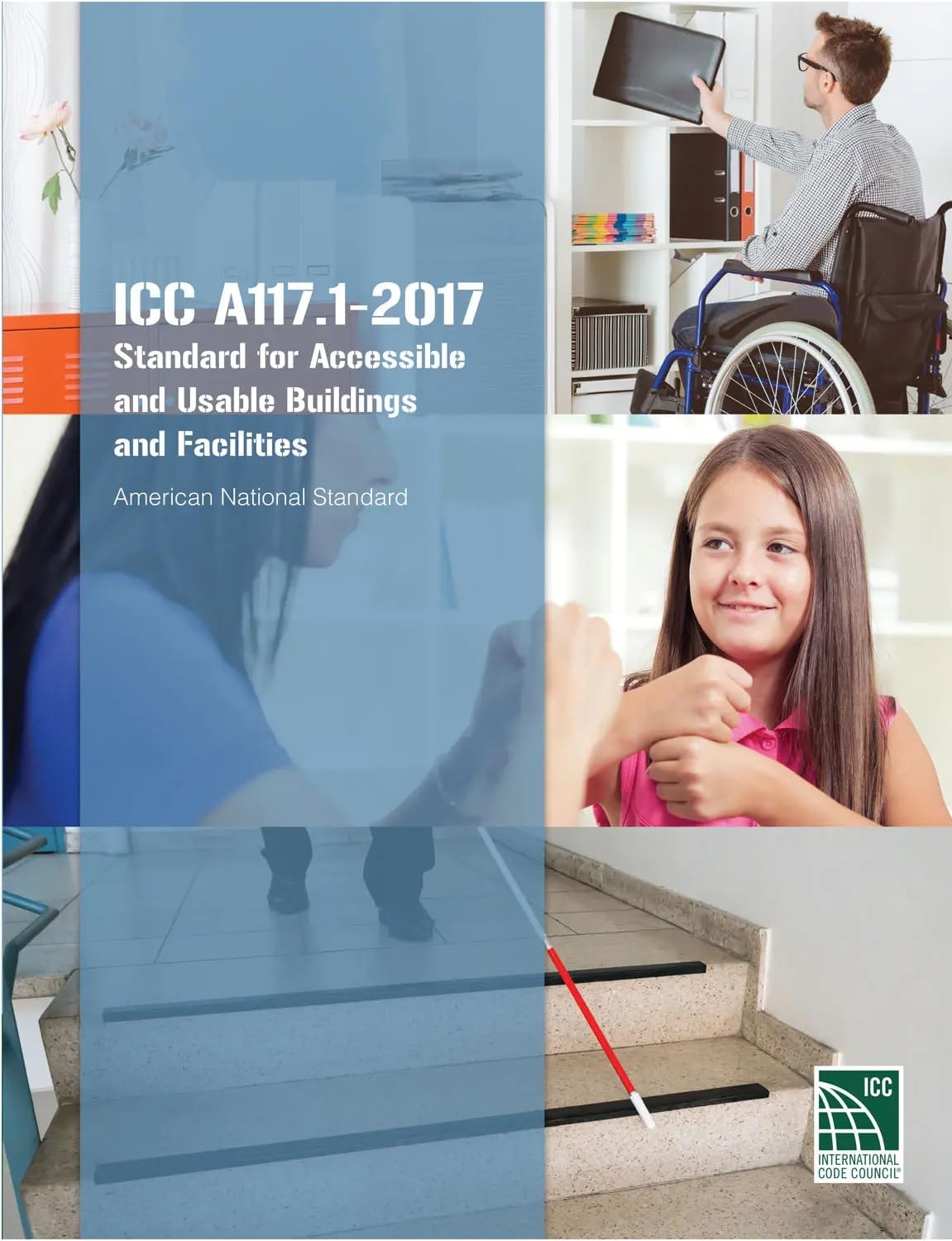
ICC A117.1-2017 Standard for Accessible and Usable Buildings and Facilities
0
0
As an Amazon Associate and affiliate partner, Menrva Books earns from qualifying purchases. Learn more
Author Description
The intent of this standard is to allow a person with physical disability to independently get to, enter, and use a site, facility, building or element. The specifications in the standard makes sites, facilities, buildings and elements accessible to and usable by people with such disabilities as the inability to walk, difficulty walking, reliance on walking aids, blindness and visual impairment, deafness and hearing impairment, incoordination, reaching and manipulation disabilities, lack of stamina, difficulty in interpreting and reacting to sensory information, and extremes in physical size.\This updated edition of the standard continues the tradition of aligning provisions with ADAAG and Fair Housing Design Guidelines, but it also provides greater accessibility for the evolving disabled communities and new elements of a building design. The standard includes:\For new buildings and additions, enhanced dimensions for the clear floor space, turning space and the accessible route. This will affect the space provided at elements and will increase the maneuverability within such spaces for users of powered wheelchairs and scooters.\Provisions incorporating many of the latest criteria for public rights of way provisions for curb cuts, blended transitions, detectable warnings, diagonal parking and street parking (PROWAG).\New provision to improve safety for an accessible route traversing a parking lot.\New provisions to facilitate charging of powered wheelchairs where they will be parked for duration, such as in accessible hotel rooms and at some wheelchair seating in assembly spaces.\New provisions addressing accessibility at electric vehicle charging stations.\New provisions for water bottle filling stations.\New provisions that address spaces for sign language interpreter stations and sign language video booths.\A new section addressing classroom acoustics that aims to improve acoustics in the rooms and to reduce the intrusion of noises from outside the classr
Menrva's Summary
THE THESIS
This standard establishes the technical requirements for accessible and usable buildings and facilities for individuals with physical disabilities. It aims to ensure that people with a wide range of impairments, including mobility, visual, and auditory challenges, can independently access and utilize sites, buildings, and their elements. The specifications cover enhanced dimensions for accessible routes, turning spaces, and clear floor spaces, along with provisions for public rights-of-way, parking safety, and charging facilities for powered mobility devices.
THE SCOPE MAP
- Enhanced dimensions for clear floor space, turning space, and accessible routes in new buildings and additions.
- Provisions for public rights-of-way, including curb cuts, blended transitions, detectable warnings, and street parking.
- New safety provisions for accessible routes traversing parking lots.
- Facilitation of charging for powered wheelchairs and scooters in accessible hotel rooms and assembly spaces.
- Accessibility provisions for electric vehicle charging stations.
- New provisions for water bottle filling stations.
- Provisions for sign language interpreter stations and sign language video booths.
- A new section addressing classroom acoustics to improve sound quality and reduce external noise.
THE AUTHORITY PERSPECTIVE
The ICC A117.1-2017 standard continues the tradition of aligning accessibility provisions with ADAAG and Fair Housing Design Guidelines, while also addressing the evolving needs of disabled communities and new building design elements. This updated edition is recognized for its comprehensive approach to enhancing accessibility, particularly in new constructions and additions, by incorporating updated dimensions and criteria for various architectural features. The inclusion of provisions for public rights-of-way, electric vehicle charging, and classroom acoustics demonstrates a forward-looking perspective on universal design.
Page Count:
176
Publication Date:
2017-01-01
Publisher:
International Code Council
ISBN-10:
1609837584
ISBN-13:
9781609837587
Non-Fiction
Architecture
Accessibility
Standards
Building Codes
Community Tags
Similar Books