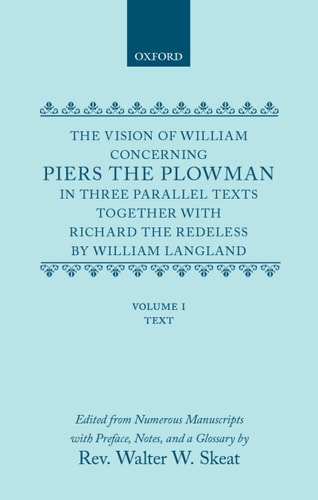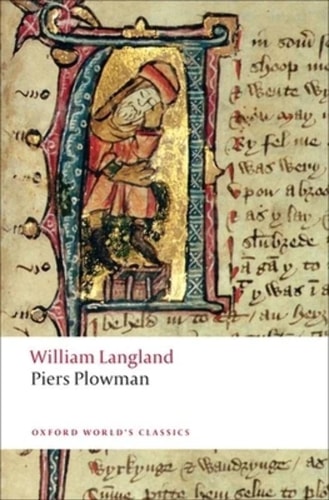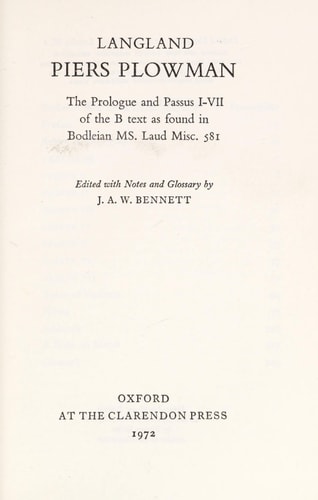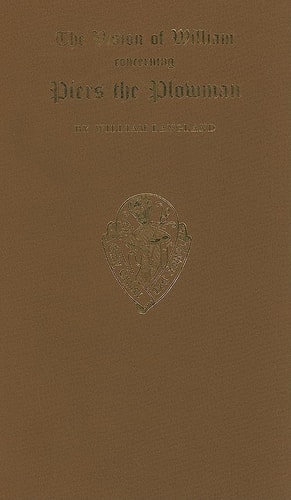
The Vision of William Concerning Piers the Plowman: Text C
0
0
As an Amazon Associate and affiliate partner, Menrva Books earns from qualifying purchases. Learn more
Author Description
A translation of the 14th century poem, which offers a picture of society in the late Middle Ages on the threshold of the early modern world. The translator of this work was a founding editor of The Norton Anthology of English Literature.
Menrva's Summary
THE PULSE
A fourteenth-century dreamer wanders the Malvern Hills, seeking spiritual clarity through a series of complex allegorical visions. The protagonist, Will, encounters personified abstractions such as Holy Church, Lady Meed, and Piers the Plowman to navigate the moral decay of his society. His objective is to understand the nature of a righteous life, specifically the distinctions between Dowel, Dobet, and Dobest. The narrative framework utilizes a dream-vision structure, employing alliterative verse to critique the corruption of the clergy and the social hierarchies of the late Middle Ages.
INSIDE THE PAGES
- Use of the traditional alliterative long line common in Middle English poetry.
- Extensive deployment of personification allegory to represent abstract virtues and vices.
- A dream-vision narrative structure that shifts between physical landscapes and metaphysical realms.
- Satirical commentary on the ecclesiastical and political institutions of the 14th century.
- Exploration of the theological concepts of Dowel, Dobet, and Dobest as stages of spiritual development.
- Integration of Latin theological citations alongside the Middle English vernacular text.
- A focus on the dignity of labor and the role of the common worker in the divine order.
- A non-linear progression that reflects the protagonist's evolving understanding of grace and salvation.
THE COLLECTIVE ECHO
Readers and scholars frequently analyze this work as a foundational text for understanding the social and religious anxieties of the late medieval period. Discussion often centers on the intricate layers of allegory and the author's ability to balance harsh social critique with profound spiritual aspiration. Critics highlight the text's linguistic complexity, noting that it serves as a primary document for the study of Middle English dialect and poetic form. The work is widely regarded as a significant contribution to the tradition of visionary literature, providing a window into the intellectual climate of the era.
Page Count:
482
Publication Date:
1873-01-01
Publisher:
Early English Text Society
ISBN-10:
0197220541
ISBN-13:
9780197220542
Poetry
Social Commentary
Allegory
Medieval
Religious
Community Tags
Similar Books