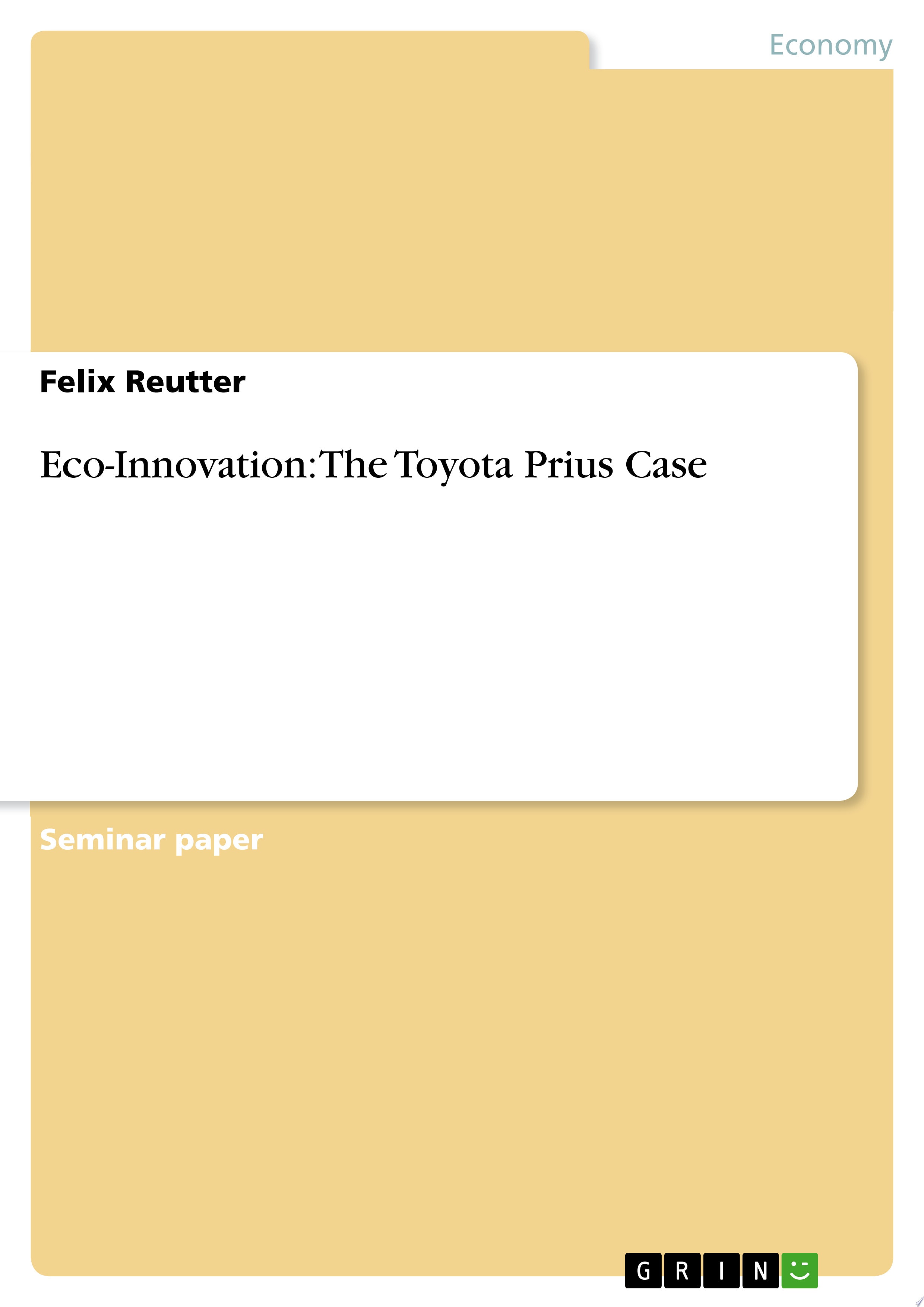
Eco-Innovation: The Toyota Prius Case
0
0
As an Amazon Associate and affiliate partner, Menrva Books earns from qualifying purchases. Learn more
Author Description
Seminar paper from the year 2013 in the subject Business economics - Operations Research, grade: 1,0, Carl von Ossietzky University of Oldenburg, language: English, abstract: The aim of this paper is to argue why the Toyota Prius can be classified as product eco-innovation and to study why the eco-innovation Toyota Prius has been successful. For this purpose the general literature on eco-innovation is reviewed and applied on the specific case of the Prius. The paper is organized as follows: section 2.1 provides a brief overview of the different definitions of the term eco-innovation that are proposed in the literature. Next, section 2.2 depicts the factors determining the success of an eco-innovation which are named in the eco-innovation literature. After this, section 3 introduces the case of the Toyota Prius and argues why the Prius can be classified as product eco-innovation. Then, section 4 studies which determinants of eco-innovation have contributed to the success of the Prius. Finally, section 5 summarizes the findings of this paper and evaluates them critically.
Menrva's Summary
THE THESIS
This paper investigates the Toyota Prius as a case study for product eco-innovation and analyzes the factors contributing to its market success. The author reviews various definitions of eco-innovation and identifies key determinants of success from existing literature. The paper then applies these concepts to the Toyota Prius, arguing for its classification as a product eco-innovation and examining which specific success factors have been instrumental in its adoption.
THE SCOPE MAP
- A review of literature on the definition of eco-innovation.
- An analysis of factors determining the success of eco-innovations.
- A detailed case study of the Toyota Prius.
- An argument for classifying the Prius as a product eco-innovation.
- An examination of the specific determinants that led to the Prius's success.
- A critical evaluation and summary of the findings.
THE AUTHORITY PERSPECTIVE
This seminar paper, originating from a 2013 academic context at the Carl von Ossietzky University of Oldenburg, presents a structured analysis of the Toyota Prius as a product eco-innovation. The work is organized to first define eco-innovation and its success factors, then apply these to the Prius case. The paper aims to critically evaluate the determinants of the Prius's success within the broader framework of environmental innovation. Its focus is on academic rigor and clear application of theory to a real-world example.
Page Count:
28
Publication Date:
2013-11-11
Publisher:
GRIN Verlag
ISBN-10:
3656538654
ISBN-13:
9783656538653
Non-Fiction
Business
Science & Technology
Operations Research
Business Economics
Community Tags
Similar Books