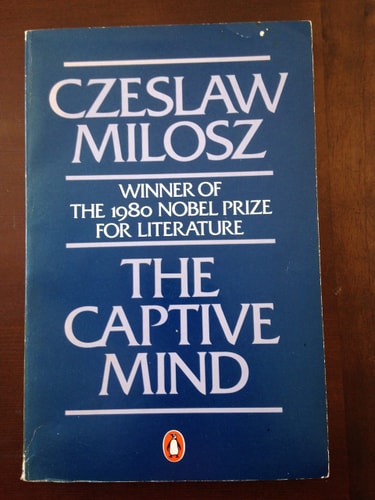
The Captive Mind
0
0
As an Amazon Associate and affiliate partner, Menrva Books earns from qualifying purchases. Learn more
Author Description
The Captive Mind begins with a discussion of the novel Insatiability by Stanisław Ignacy Witkiewicz and its plot device of Murti-Bing pills, which are used as a metaphor for dialectical materialism, but also for the deadening of the intellect caused by consumerism in Western society. The second chapter considers the way in which the West was seen at the time by residents of Central and Eastern Europe, while the third outlines the practice of Ketman, the act of paying lip service to authority while concealing personal opposition, describing seven forms applied in the people's democracies of mid-20th century Europe.The four chapters at the heart of the book then follow, each a portrayal of a gifted Polish man who capitulated, in some fashion, to the demands of the Communist state. They are identified only as Alpha, the Moralist; Beta, The Disappointed Lover; Gamma, the Slave of History; and Delta, the Troubadour. However, each of the four portraits were easily identifiable: Alpha is Jerzy Andrzejewski, Beta is Tadeusz Borowski, Gamma is Jerzy Putrament and Delta is Konstanty Ildefons Gałczyński.The book moves toward its climax with an elaboration of "enslavement through consciousness" in the penultimate chapter and closes with a pained and personal assessment of the fate of the Baltic nations in particular.
Menrva's Summary
THE THESIS
How does a totalitarian state successfully manipulate the intellectual consciousness of its citizens to ensure compliance and ideological conformity? Czeslaw Milosz, a Nobel Prize-winning poet and diplomat who defected from the Polish People's Republic, utilizes his firsthand experience and observations of mid-20th-century Eastern Europe to analyze the psychological mechanisms of political subjugation. He argues that the state does not merely demand external obedience but seeks to colonize the internal life of the individual through fear, social pressure, and the systematic erosion of independent thought.
THE SCOPE MAP
What You Will Find
- A detailed examination of the concept of Ketman, the practice of feigning loyalty to authority while harboring private dissent.
- Four case studies of prominent Polish intellectuals who succumbed to the pressures of the Communist regime.
- An analysis of the metaphor of the Murti-Bing pill as a tool for intellectual pacification.
Scope Limits
- The text does not provide a comprehensive history of the Cold War, focusing instead on the specific intellectual climate of post-war Poland.
- It does not offer a prescriptive political solution, remaining primarily a diagnostic work of social and psychological observation.
THE AUTHORITY PERSPECTIVE
Scholars and critics widely regard this work as a foundational text for understanding the psychological toll of totalitarianism on the creative class. Readers frequently note the profound, often haunting, clarity of Milosz's prose as he navigates the complex moral compromises made by his contemporaries.
Page Count:
272
Publication Date:
1980-12-11
Publisher:
PENGUIN BOOKS LTD
ISBN-10:
0140058753
ISBN-13:
9780140058758
Philosophy
Memoir
History
Politics
Eastern European Studies
Human rights
Sociology
Constitutional Law
Community Tags
Similar Books