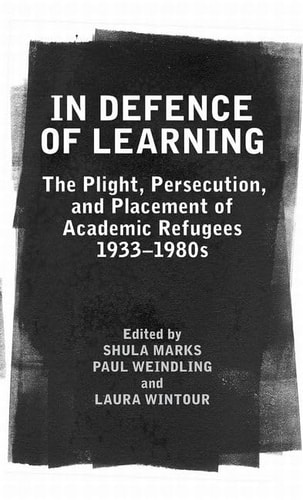
In Defence of Learning: The Plight, Persecution, and Placement of Academic Refugees, 1933-1980s
0
0
As an Amazon Associate and affiliate partner, Menrva Books earns from qualifying purchases. Learn more
Author Description
Established in the 1930s to rescue scientists and scholars from Nazi Europe, the Society for the Protection of Science and Learning (SPSL, founded in 1933 as the Academic Assistance Council and now known as the Council for Assisting Refugee Academics) has had an illustrious career. No fewer than eighteen of its early grantees became Nobel Laureates and 120 were elected Fellows of the British Academy and Royal Society in the UK. While a good deal has been written on the SPSL in the 1930s and 1940s, and especially on the achievements of the outstanding scientists rescued, much less attention has been devoted to the scholars who contributed to the social sciences and humanities, and there has been virtually no research on the Society after the Second World War. The archive-based essays in this volume, written to commemorate the 75th anniversary of the organisation, are the first to attempt to fill this gap. The essays include revisionist accounts of the founder of the SPSL and some of its early grantees. For the first time, the story examines its relationship with associates and allies, the experiences of women academics and those of the post- war academic refugees from Communist Europe, apartheid South Africa and Pinochet's Chile. In addition to scholarly contributions, the volume includes moving essays by the children of early grantees. At a time of increasing international concern with refugees and immigration, it is a timely reminder of the enormous contribution generations of academic refugees have made - and continue to make - to learning the world over.
Menrva's Summary
THE THESIS
This volume investigates the historical impact and institutional evolution of the Society for the Protection of Science and Learning (SPSL) in supporting displaced scholars from 1933 through the late 20th century. The authors, including historians Laura Wintour, Paul Julian Weindling, and Shula Marks, utilize archival records to broaden the historical narrative beyond the initial rescue efforts of the 1930s. By examining the experiences of academics from diverse geopolitical contexts—including Nazi Europe, Communist regimes, apartheid South Africa, and Pinochet's Chile—the text argues for the enduring significance of academic migration in the global advancement of knowledge.
THE SCOPE MAP
What You Will Find
- Historical analysis of the SPSL from its 1933 founding through the 1980s.
- Examination of the experiences of women academics and scholars from non-European regions.
- Primary source-based research including archival essays and personal accounts from descendants of grantees.
- Comparative study of academic displacement across different political regimes and eras.
THE AUTHORITY PERSPECTIVE
Experts recognize this collection as a vital expansion of the literature surrounding the SPSL, specifically for its focus on the post-war era and the humanities. Readers frequently note the academic density of the prose and the value of the inclusion of personal narratives alongside institutional history.
Page Count:
304
Publication Date:
2011-09-15
Publisher:
British Academy
ISBN-10:
0197264816
ISBN-13:
9780197264812
Biography
History
Academic
Sociology
Refugees
Community Tags
Similar Books