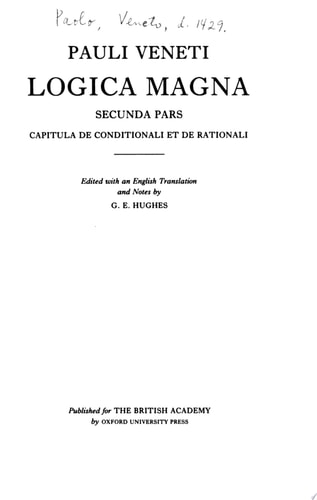
Logica Magna: Part II Fascicule 4: Capitula de Conditionali et de Rationali
0
0
As an Amazon Associate and affiliate partner, Menrva Books earns from qualifying purchases. Learn more
Author Description
In this fascicule Paul examines conditional propositions and inferences. Detailed notes make Paul's terminology and background ideas and assumptions more accessible to the modern reader, and an appendix contains substantial extracts from the writings of two fourteenth-century logicians, Ralph Strode and John Venator, both of whose works Paul makes extensive use of in this part of the Logica Magna.
Menrva's Summary
THE THESIS
This volume investigates the formal structure of conditional propositions and the mechanics of logical inference as articulated by the fourteenth-century philosopher Paul of Venice. Paul of Venice, a prominent figure in late medieval scholasticism, synthesizes complex logical traditions to refine the rules governing rational discourse. The text provides a rigorous examination of how conditional statements function within the broader framework of medieval logic, utilizing both original analysis and critical engagement with contemporary thinkers. By contextualizing these arguments, the author clarifies the underlying assumptions that defined the intellectual landscape of the period.
THE SCOPE MAP
What You Will Find
- Analysis of conditional propositions and their role in formal inference.
- Detailed annotations explaining medieval logical terminology and conceptual frameworks.
- Primary source extracts from the works of Ralph Strode and John Venator.
- A critical examination of fourteenth-century scholastic logic and its application.
THE AUTHORITY PERSPECTIVE
Scholars and historians of philosophy regard this text as a vital resource for understanding the technical sophistication of late medieval logic. Readers frequently note the academic density of the prose, which is balanced by extensive notes that assist in navigating the complex scholastic methodology employed by Paul of Venice.
Page Count:
582
Publication Date:
1990-09-13
Publisher:
Oxford University Press
ISBN-10:
0197260942
ISBN-13:
9780197260944
History
Philosophy
Logic Ancient
Academic
Logic
Logic Medieval
Community Tags
Similar Books