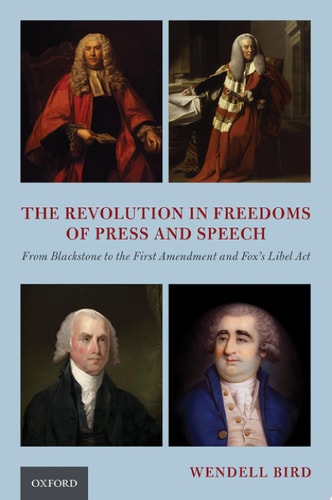
The Revolution in Freedoms of Press and Speech: From Blackstone to the First Amendment and Fox's Libel Act
0
0
As an Amazon Associate and affiliate partner, Menrva Books earns from qualifying purchases. Learn more
Author Description
This book discusses the revolutionary broadening of concepts of freedom of press and freedom of speech in Great Britain and in America in the late eighteenth century, in the period that produced state declarations of rights and then the First Amendment and Fox's Libel Act.The conventional view of the history of freedoms of press and speech is that the common law since antiquity defined those freedoms narrowly, and that Sir William Blackstone in 1769, and Lord Chief Justice Mansfield in 1770, faithfully summarized the common law in giving a very narrow definition of those freedoms as mere liberty from prior restraint and not liberty from punishment after something was printed or spoken.This book proposes, to the contrary, that Blackstone carefully selected the narrowest definition that had been suggested in popular essays in the prior seventy years, in order to oppose the growing claims for much broader protections of press and speech. Blackstone misdescribed his summary as an accepted common law definition, which in fact did not exist. A year later, Mansfield inserted a similar definition into the common law for the first time, also misdescribing it as a long-accepted definition, and soon misdescribed the unique rules for prosecuting sedition as having an equally ancient pedigree. Blackstone and Mansfield were not declaring the law as it had long been, but were leading a counter-revolution about the breadth of freedoms of press and speech, and cloaking it as a summary of a narrow common law doctrine that in fact was nonexistent.That conflict of revolutionary view and counter-revolutionary view continues today. For over a century, a neo-Blackstonian view has been dominant, or at least very influential, among historians. Contrary to those narrow claims, this book concludes that the broad understanding of freedoms of press and speech was the dominant context of the First Amendment and of Fox's Libel Act, and that it enjoyed greater historical support.
Menrva's Summary
THE THESIS
This book investigates the historical origins of freedom of the press and speech, challenging the conventional narrative that these rights were narrowly defined by common law prior to the late eighteenth century. Wendell R. Bird, a legal historian, examines the influence of Sir William Blackstone and Lord Chief Justice Mansfield on the development of legal doctrine. He argues that these figures actively promoted a restrictive interpretation of speech rights as a counter-revolutionary measure, effectively misrepresenting the broader, more prevalent understanding of these liberties that informed the First Amendment and Fox's Libel Act.
THE SCOPE MAP
What You Will Find
- A detailed analysis of eighteenth-century legal treatises and judicial decisions in Great Britain and America.
- A critical examination of the influence of Blackstone and Mansfield on modern legal historiography.
- Primary source evidence contrasting narrow common law interpretations with broader contemporary understandings of press freedom.
- A re-evaluation of the historical context surrounding the drafting of the First Amendment and Fox's Libel Act.
THE AUTHORITY PERSPECTIVE
Legal scholars and historians recognize this work as a significant challenge to the neo-Blackstonian consensus that has dominated legal history for over a century. Readers frequently note the academic density of the prose and the meticulous archival research used to support the author's revisionist arguments.
Page Count:
408
Publication Date:
2020-02-28
Publisher:
Oxford University Press
ISBN-10:
0197509193
ISBN-13:
9780197509197
History
Non-Fiction
Constitutional Law
Professional Career & Trade
Law
United States
Freedom of speech
Freedom of the press
Community Tags
Similar Books