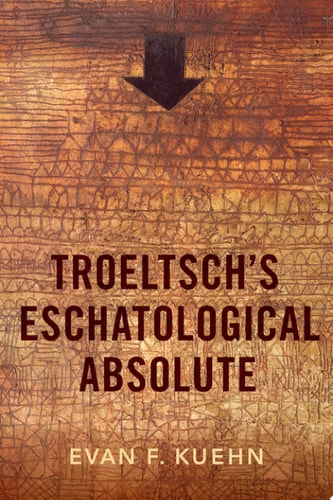
Troeltsch's Eschatological Absolute (AAR Academy Series)
0
0
As an Amazon Associate and affiliate partner, Menrva Books earns from qualifying purchases. Learn more
Author Description
Ernst Troeltsch is widely recognized as having played an important role in the development of modern Protestant theology, but his contribution is usually understood as largely critical of traditional modes of theological inquiry. He is best known for his historicist critique of dogmatic theology, and seen either as the closing chapter of nineteenth-century liberalism, or as a proto-postmodernist. Central to this pivotal period in modern theology stands the problem: how can we articulate a doctrine of ultimate reality such that a meaningful and coherent account of the world is available without our understanding of God thereby becoming conditioned by the world itself? Evan Kuehn demonstrates that historiographical assumptions about twentieth-century religious thought have obscured the coherence and relevance of Troeltsch's understanding of God, history, and eschatology. An eschatological understanding of the Absolute, Kuehn contends, stands at the heart of Troeltsch's theology and the problem of historicism with which it is faced. Troeltsch's eschatological Absolute must be understood in the context of questions that were being raised at the turn of the twentieth century both by research on New Testament apocalypticism, and by modern critical methodologies in the historical sciences. His theory of the Absolute is central to his views on religion and religious ethics and provides practitioners of constructive studies in religion with important resources for engaging with sociological and historical studies, where Troeltsch's status as a classical figure is widely recognized.
Menrva's Summary
THE THESIS
This book investigates how Ernst Troeltsch’s concept of an eschatological Absolute provides a coherent framework for modern theology amidst the challenges of historicism. Evan F. Kuehn, a scholar of modern religious thought, challenges the prevailing view that Troeltsch’s work is merely a critical or destructive force in Protestant theology. By re-examining Troeltsch’s writings in the context of early twentieth-century debates on apocalypticism and historical methodology, Kuehn argues that an eschatological understanding of the Absolute serves as the constructive core of his theological system. This study seeks to restore the relevance of Troeltsch’s thought for contemporary constructive theology and its engagement with the social sciences.
THE SCOPE MAP
What You Will Find
- An analysis of the intersection between nineteenth-century liberal theology and early twentieth-century historical criticism.
- A re-evaluation of Troeltsch’s engagement with New Testament apocalypticism and its influence on his doctrine of God.
- A methodological framework for reconciling the tension between absolute theological claims and historical contingency.
- An exploration of how Troeltsch’s theory of the Absolute informs his perspectives on religious ethics and sociological inquiry.
THE AUTHORITY PERSPECTIVE
Scholars in the field of systematic theology and religious history recognize this work as a significant intervention in the interpretation of Ernst Troeltsch. Readers frequently note the academic density of the prose, which is intended for advanced students and researchers of modern Protestant thought.
Page Count:
202
Publication Date:
2020-01-01
Publisher:
Oxford University Press
ISBN-10:
0197506674
ISBN-13:
9780197506677
History
Religion
Philosophy
Theology
Eschatology
Academic
Community Tags
Similar Books