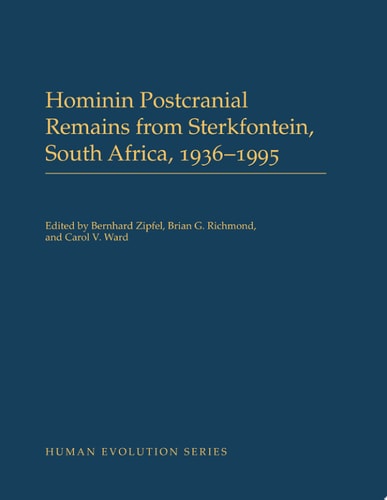
Hominin Postcranial Remains from Sterkfontein, South Africa, 1936-1995 (Human Evolution Series)
0
0
As an Amazon Associate and affiliate partner, Menrva Books earns from qualifying purchases. Learn more
Author Description
The 1924 African discovery of an early hominin child's skull, referred to as Australopithecus africanus by Raymond Dart, was a major event in the history of paleoanthropology. This provided the first evidence of early hominins in Africa and overturned conventional ideas about human evolution. Subsequent discoveries of A. africanus fossils, notably from cave deposits at Sterkfontein, yielded the first evidence that early hominins were habitual bipeds. Fifty years after this, the discovered wealth of fossil evidence in eastern Africa of the slightly older and craniodentally more primitive taxon, A. afarensis, catalyzed debates about the origin and evolution of human gait and the phylogentic relationships among early hominins. This formed the main basis of our understanding of early hominin bipedality and paleobiology. Little attention has been paid to the variation among species in postcranial anatomy and locomotion, although intriguing hints are beginning to appear in the literature. Did multiple varieties of bipedality evolve? Did australopith species differ in positional or manipulative abilities, body proportions, or patterns of sexual dimorphism? These are critical questions for understanding the evolution of australopiths and hominin locomotion.In this book, Bernhard Zipfel, Brian Richmond, Carol Ward, and the most knowledgeable scholars in their respective fields provide groundbreaking accounts for each postcranial fossil and expert examinations into the background of each fossil. The chapters include standardized high-quality photographs and anatomical descriptions to allow readers to read the book entirely or learn by comparing features across chapters. Hominin Postcranial Remains from Sterkfontein, South Africa, 1936-1995 is an evolutionary history of South African hominins, and it offers readers an orientation and introduction to the field. This is an important reference book for professional paleontologists, paleobiologists, anthropologists, geologists, st
Menrva's Summary
THE THESIS
This volume investigates the morphological variation and functional significance of postcranial fossil remains recovered from the Sterkfontein caves between 1936 and 1995 to clarify the evolution of early hominin locomotion. The authors, including Bernhard Zipfel, Brian G. Richmond, and Carol V. Ward, synthesize decades of fossil discoveries to address whether multiple forms of bipedality existed among early australopiths. By providing standardized anatomical descriptions and photographic evidence, the text establishes a comparative framework for analyzing body proportions, sexual dimorphism, and positional behaviors in the fossil record. This work serves as a critical resource for evaluating the phylogenetic relationships and paleobiological diversity of South African hominins.
THE SCOPE MAP
What You Will Find
- Comprehensive cataloging of postcranial fossil remains from the Sterkfontein site spanning 1936 to 1995.
- Standardized anatomical descriptions and high-quality photographic documentation for comparative analysis.
- Detailed examinations of body proportions, manipulative abilities, and patterns of sexual dimorphism.
- Methodological approaches to interpreting early hominin gait and locomotor evolution.
THE AUTHORITY PERSPECTIVE
Experts recognize this volume as a foundational reference for professional paleontologists and anthropologists specializing in human evolution. Readers frequently note the technical density of the anatomical data, which serves as a primary source for researchers comparing fossil features across the australopith lineage.
Page Count:
387
Publication Date:
2020-01-01
Publisher:
Oxford University Press
ISBN-10:
0197507689
ISBN-13:
9780197507681
Science
History
Taxonomy
Paleontology
Evolutionary Biology
Anthropology
Zoology
Community Tags
Similar Books










Reader Comments
Share Your Thoughts
No comments yet. Be the first to share your thoughts!