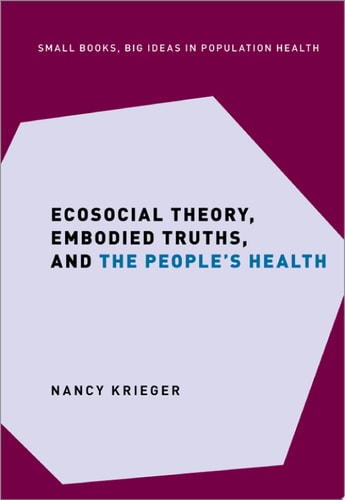
Ecosocial Theory, Embodied Truths, and the People's Health (Small Books Big Ideas in Population Health)
0
0
As an Amazon Associate and affiliate partner, Menrva Books earns from qualifying purchases. Learn more
Author Description
From public health luminary Nancy Krieger comes a revolutionary way of addressing health justice and the embodied truths of lived experience.Since the 1700s, fierce debates in medicine and public health have centered around whether sources of ill health can be attributed to either the individual or the surrounding body politic. But what if instead health researchers measure--and policies address--how people biologically embody their societal and ecological context?Ecosocial Theory, Embodied Truths, and the People's Health represents a daring new foray into analyzing how population patterns of health reveal the intersections of lived experience and biology in historical context. Expanding on Nancy Krieger's original ecosocial theory of disease distribution, this volume lays new theoretical groundwork about embodiment and health justice through concrete and novel examples involving pathways such as workplace discrimination, relationship abuse, Jim Crow, police violence, pesticides, fracking, green space, and climate change. It offers a crucial counterargument to dominant biomedical and public health narratives attributing causality to either innate biology or decontextualized health behaviors and provides a key step forward towards understanding and addressing the structural drivers of health inequities and health justice.Bridging insights from politics, history, sociology, ecology, biology, and public health, Ecosocial Theory, Embodied Truths, and the People's Health presents a bold new framework to transform biomedical and population health thinking, practice, and policies and to advance health equity across a deeply threatened planet.
Menrva's Summary
THE THESIS
This work investigates how population health patterns reveal the complex intersections between lived experience, societal structures, and biological outcomes. Nancy Krieger, a prominent figure in public health, utilizes her established ecosocial theory to challenge the binary debate that attributes illness solely to individual behavior or innate biology. By proposing that humans biologically embody their ecological and societal contexts, the author provides a framework for addressing structural drivers of health inequities and advancing health justice.
THE SCOPE MAP
What You Will Find
- Theoretical analysis of embodiment as a mechanism for disease distribution.
- Interdisciplinary synthesis of politics, history, sociology, and biology.
- Case studies examining workplace discrimination, police violence, and environmental factors like fracking and climate change.
- Methodological approaches for shifting public health policy toward structural equity.
THE AUTHORITY PERSPECTIVE
Experts recognize this volume as a significant expansion of Krieger's foundational work on disease distribution. Readers frequently note the academic density of the prose, which serves as a rigorous resource for researchers and practitioners in population health.
Page Count:
351
Publication Date:
2021-01-01
Publisher:
Oxford University Press
ISBN-10:
0197510744
ISBN-13:
9780197510742
Philosophy
MEDICAL History
Allied Health
Medical
Public Health
Environmental Health
Social justice
Epidemiology
Sociology
Community Tags
Similar Books