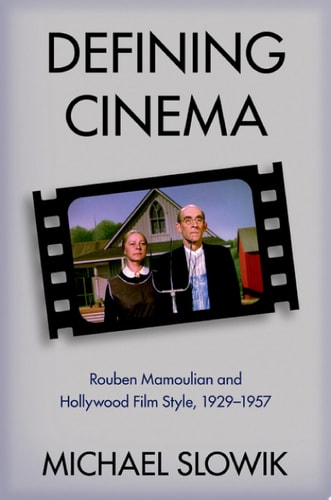
Defining Cinema: Rouben Mamoulian and Hollywood Film Style, 1929-1957
0
0
As an Amazon Associate and affiliate partner, Menrva Books earns from qualifying purchases. Learn more
Author Description
Arriving in cinema when synchronized sound had just been adopted, director Rouben Mamoulian demonstrated key early methods for making sound aid storytelling, for giving films a crisper sense of rhythm, for creating musicals set in backstage, fairy-tale, and folk environments, for providing intricate and arresting colour palettes, and for rendering sexual content more palpable under industry censorship. Mamoulian also wrote many articles throughout his lifetime and gave interviews and lectures where he advanced his complex ideas about the potentials of various artforms, including cinema. In addition, he left an extensive paper record of his work, including heavily annotated scripts for each of the sixteen films he directed. Mamoulian also enjoyed major success on the stage. He directed the original landmark productions of Porgy, Porgy and Bess, Oklahoma!, and Carousel, and his efforts in this domain informed his film work.Defining Cinema takes a holistic look at Mamoulian's oeuvre by examining both his stage and his screen work, and also brings together insights from his correspondence, his theories on film, and analysis of the films themselves. It presents a filmmaker whose work was innovative and exciting, who pushed hard on cinema's potential as an artform, and who in many ways helped move cinema towards the kind of entertainment that it remains today. The book thus tells a story that is vital not just for better understanding the work of a neglected filmmaker, but for anyone interested in the history of Hollywood filmmaking.
Menrva's Summary
THE THESIS
How did Rouben Mamoulian’s innovative approach to sound, color, and stagecraft shape the evolution of Hollywood film style between 1929 and 1957? Michael Slowik, a scholar of film history, utilizes a comprehensive examination of Mamoulian’s directorial career to argue that his work was foundational in establishing modern cinematic language. By synthesizing archival research, including annotated scripts and personal correspondence, with formal analysis of his sixteen films, Slowik demonstrates how Mamoulian bridged the gap between theatrical performance and early sound cinema. The author posits that Mamoulian’s unique background in stage production allowed him to push the boundaries of industry censorship and aesthetic expression during a critical period of Hollywood development.
THE SCOPE MAP
What You Will Find
- Analysis of Mamoulian’s sixteen feature films produced between 1929 and 1957.
- Examination of the transition from silent film to synchronized sound techniques.
- Integration of primary source materials such as annotated scripts, lectures, and personal correspondence.
- Comparative study of his landmark stage productions, including Oklahoma! and Carousel, and their influence on his filmic rhythm and color palettes.
THE AUTHORITY PERSPECTIVE
Scholars and film historians view this text as a significant contribution to the study of mid-century Hollywood directors. The book is frequently cited for its meticulous use of archival evidence to provide a nuanced understanding of Mamoulian’s technical contributions to the medium.
Page Count:
328
Publication Date:
2024-01-01
Publisher:
Oxford University Press
ISBN-10:
0197511236
ISBN-13:
9780197511237
Biography
Cinema Studies
Film History
Hollywood
Community Tags
Similar Books