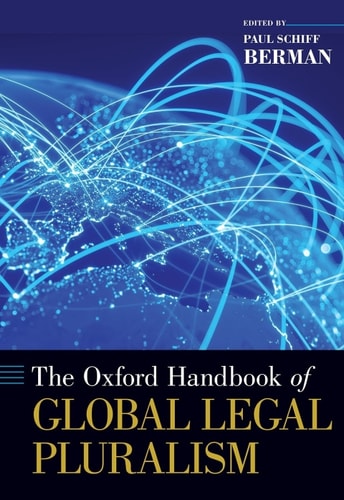
The Oxford Handbook of Global Legal Pluralism (Oxford Handbooks)
0
0
As an Amazon Associate and affiliate partner, Menrva Books earns from qualifying purchases. Learn more
Author Description
Over the past two decades Global Legal Pluralism has become one of the leading analytical frameworks for understanding and conceptualizing law in the 21st century. Wherever one looks, there is conflict among multiple legal regimes. Some of these regimes are state-based, some are built and maintained by non-state actors, some fall within the purview of local authorities and jurisdictional entities, and some involve international courts, tribunals, and arbitral bodies, and regulatory organizations.Global Legal Pluralism has provided, first and foremost, a set of useful analytical tools for describing this conflict among legal and quasi-legal systems. At the same time, some pluralists have also ventured in a more normative direction, suggesting that legal systems might sometimes purposely create legal procedures, institutions, and practices that encourage interaction among multiple communities. These scholars argue that pluralist approaches can help foster more shared participation in the practices of law, more dialogue across difference, and more respect for diversity without requiring assimilation and uniformity.Despite the veritable explosion of scholarly work on legal pluralism, conflicts of law, soft law, global constitutionalism, the relationships among relative authorities, transnational migration, and the fragmentation and reinforcement of territorial boundaries, no single work has sought to bring together these various scholarly strands, place them into dialogue with each other, or connect them with the foundational legal pluralism research produced by historians, anthropologists, and political theorists.Paul Schiff Berman, one of the world's leading theorists of Global Legal Pluralism, has gathered over 40 diverse authors from multiple countries and multiple scholarly disciplines to touch on nearly every area of legal pluralism research, offering defenses, critiques, and applications of legal pluralism to 21st-century legal analysis. Berman also provides introductory and concluding chapters that synthesize the various contributions.
Menrva's Summary
THE THESIS
How can legal scholars and practitioners effectively conceptualize and navigate the complex, overlapping, and often conflicting legal regimes that define the 21st-century global landscape? Paul Schiff Berman, a prominent theorist in the field, compiles a comprehensive collection of research to address the fragmentation of authority across state, non-state, and international jurisdictions. By integrating historical, anthropological, and political perspectives, the text establishes a unified framework for analyzing how diverse legal systems interact, compete, and potentially cooperate in an increasingly interconnected world.
THE SCOPE MAP
What You Will Find
- Comprehensive analysis of legal pluralism, soft law, and global constitutionalism.
- Interdisciplinary research bridging law, history, anthropology, and political theory.
- Case studies and theoretical critiques from over 40 international scholars.
- Methodological tools for managing jurisdictional conflicts and transnational legal interactions.
THE AUTHORITY PERSPECTIVE
Experts identify this volume as a definitive reference for scholars and practitioners seeking to understand the intersection of multiple legal orders. Readers frequently note the academic density of the prose, which serves as a foundational resource for advanced study in international and comparative law.
Page Count:
1136
Publication Date:
2020-01-01
Publisher:
Oxford University Press
ISBN-10:
0197516769
ISBN-13:
9780197516768
International Law
Professional Career & Trade
Law
Legal Theory
Sociology of Law
Community Tags
Similar Books