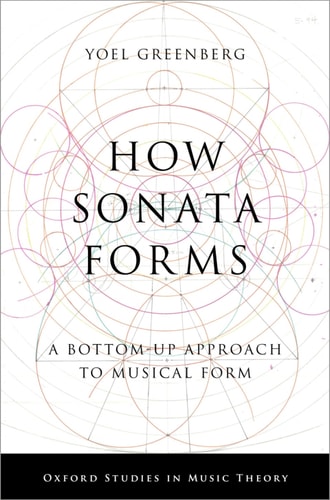
How Sonata Forms: A Bottom-Up Approach to Musical Form
0
0
As an Amazon Associate and affiliate partner, Menrva Books earns from qualifying purchases. Learn more
Author Description
Traditional approaches to musical form have always adopted a top-down perspective whereby a work's form organizes and unifies the individual parts of the work through an overarching logic. How Sonata Forms turns this view on its head, proposing instead that it was the parts that conditioned and enabled the whole. Relying on a corpus of over a thousand works, author Yoel Greenberg illustrates how the elements of sonata form arose independently of one another, with an overarching idea of form only emerging at the tail end of its formative period during the eighteenth century. Appreciation of the bottom-up nature of sonata form's evolution reveals it not as a stable package of features that all serve a common aesthetic or formal goal, but rather as an unstable collection of disparate and sometimes even contradictory common practices. The resolution of these contradictions presents a challenge to composers, rendering form a creative catalyst in itself, rather than as a compositional convenience. More generally, the deeply diachronic perspective of How Sonata Forms offers an alternative to the traditional synchronic outlook that pervades music theory in general and the study of form in particular. Rather than focus on definitions and taxonomies, How Sonata Forms proposes a focus on the motion of the system of form as a whole, suggesting that it is often more productive to appreciate the dynamics of a system than it is to rigorously define its parts.
Menrva's Summary
THE THESIS
How Sonata Forms investigates whether musical form is a top-down organizational structure or an emergent property derived from the independent evolution of individual musical parts. Author Yoel Greenberg, a scholar in music theory, challenges the traditional synchronic view of sonata form by analyzing a massive corpus of over one thousand eighteenth-century works. He argues that the sonata form was not a pre-existing aesthetic blueprint but an unstable collection of disparate practices that only coalesced into a unified system at the end of its formative period. By shifting the focus from static definitions to the diachronic motion of the system, Greenberg presents form as a creative catalyst for composers rather than a rigid compositional constraint.
THE SCOPE MAP
What You Will Find
- A corpus-based analysis of over one thousand musical works from the eighteenth century.
- A diachronic methodology that tracks the independent evolution of individual formal elements.
- A critique of traditional top-down music theory taxonomies and definitions.
- An exploration of how contradictory common practices functioned as creative challenges for composers.
THE AUTHORITY PERSPECTIVE
Experts recognize this work as a significant departure from standard pedagogical approaches to musical form, favoring a data-driven, evolutionary perspective. Readers frequently note the academic density of the prose, which is intended for advanced students and scholars of music theory.
Page Count:
264
Publication Date:
2022-01-01
Publisher:
Oxford University Press
ISBN-10:
0197526306
ISBN-13:
9780197526309
History
Music
Music theory
Music Technology
Academic
European History
Humanities
Music History
Musicology
Community Tags
Similar Books