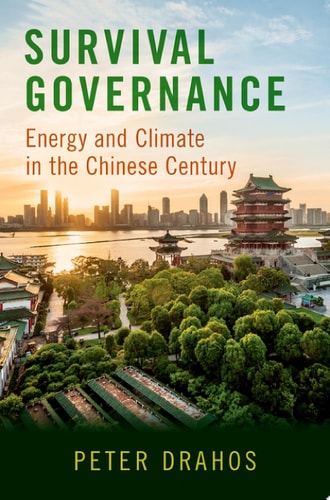
Survival Governance: Energy and Climate in the Chinese Century
0
0
As an Amazon Associate and affiliate partner, Menrva Books earns from qualifying purchases. Learn more
Author Description
To deal with the climate crisis we need a new paradigm of technological and social development aimed at the restoration of ecological systems--the bio-digital energy paradigm--and China is the world power best positioned to lead this change.The climate and energy crisis requires a strong state to change the direction, speed, and scale of innovation in world capitalism. There are only a few possible contenders for catalyzing this governance of survival: China, the European Union, India, and the United States. While China is an improbable leader--and in fact the world's biggest emitter of greenhouse gasses--Peter Drahos explains in Survival Governance why this authoritarian state is actually more likely to implement systemic change swiftly and effectively than any other power. Drawing on more than 250 interviews, carried out in 17 countries--including the world's four largest carbon emitters--Drahos shows what China is doing to make its vast urban network sustainable and why all states must work toward a "bio-digital energy paradigm" based on a globalized, city-based network of innovation. As Drahos explains, America is incapable of reducing the power of its fossil fuel industry. For its part, the European Union's approach is too incremental and slowed by complex internal negotiations to address a crisis that demands a rapid response. India's capacity to be a global leader on energy innovation is questionable. To be sure, China faces hurdles too. Its coal-based industrial system is enormous, and the US, worried about losing technological superiority, is trying to slow China's development. Even so, China is currently urbanizing innovation on a historically unprecedented scale, building eco-cities, hydrogen cities, forest cities, and sponge cities (designed to cope with flooding). This has the potential to move cities into a new relationship with their surrounding ecosystems. China--given the size of its economy and the central government's ability to dictate thoroughgo
Menrva's Summary
THE THESIS
Can an authoritarian state effectively lead the global transition toward a sustainable bio-digital energy paradigm to mitigate the climate crisis? Peter Drahos, a scholar of intellectual property and global governance, utilizes extensive field research to argue that China possesses the unique structural capacity to catalyze systemic change in world capitalism. By contrasting China's centralized urban innovation with the political gridlock of the United States and the incrementalism of the European Union, the author posits that a state-led, city-based network of innovation is the most viable path for ecological restoration.
THE SCOPE MAP
What You Will Find
- Analysis of the bio-digital energy paradigm as a framework for ecological sustainability.
- Comparative assessment of climate governance models in China, the European Union, India, and the United States.
- Qualitative data derived from over 250 interviews conducted across 17 countries.
- Examination of urban planning initiatives including eco-cities, hydrogen cities, and sponge cities.
THE AUTHORITY PERSPECTIVE
Experts recognize this work as a provocative contribution to the discourse on climate governance and state capacity. Readers frequently note the author's departure from conventional Western political analysis in favor of a pragmatic, structural evaluation of China's industrial and environmental policies.
Page Count:
270
Publication Date:
2021-01-01
Publisher:
Oxford University Press
ISBN-10:
0197534775
ISBN-13:
9780197534779
International relations
Energy policy
China Studies
Climate Change
Professional Career & Trade
Public Policy
Community Tags
Similar Books