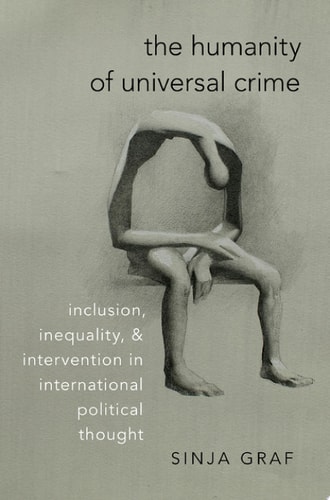
The Humanity of Universal Crime: Inclusion, Inequality, and Intervention in International Political Thought
0
0
As an Amazon Associate and affiliate partner, Menrva Books earns from qualifying purchases. Learn more
Author Description
The international crime of "crimes against humanity" has become integral to contemporary political and legal discourse. However, the conceptual core of the term--an act against all of mankind--has a longer and deeper history in international political thought. In an original excavation of this history, The Humanity of Universal Crime examines theoretical mobilizations of the idea of universal crime in colonial and post-colonial contexts. Sinja Graf demonstrates the overlooked centrality of humanity and criminality to political liberalism's historical engagement with world politics, thereby breaking with the exhaustively studied status of individual rights in liberal thought. Graf argues that invocations of universal crime project humanity as a normatively integrated, yet minimally inclusive and hierarchically structured subject. Such visions of humanity have in turn underwritten justifications of foreign rule and outsider intervention based on claims to an injury universally suffered by all mankind. Foregrounding the "political productivity" of universal crime, the book traces the intellectual history of the rise, fall, and reappearance of notions of universal crime in political theory over time. It looks particularly at the way European theorists have deployed the concept in assessing the legitimacy of colonial rule and foreign intervention in non-European societies. The book argues that an "inclusionary Eurocentrism" subtends the authorizing and coercive dimensions of universal crime. Unlike much-studied "exclusionary Eurocentrist" thinking, "inclusionary Eurocentrist" arguments have historically extended an unequal, repressive "recognition via liability" to non-European peoples. Overall the book offers a novel view of how claims to act in the name of humanity are deeply steeped in practices that reproduce structures of inequality at a global level, particularly across political empires.
Menrva's Summary
THE THESIS
This work investigates how the concept of 'crimes against humanity' has functioned as a tool for justifying foreign intervention and maintaining hierarchical global structures throughout history. Sinja Graf, a scholar of international political thought, utilizes an intellectual history framework to analyze how European theorists have historically deployed the idea of universal crime. By examining the shift from colonial to post-colonial contexts, the author argues that the concept relies on an 'inclusionary Eurocentrism' that grants non-European peoples recognition only through the lens of liability and potential criminality.
THE SCOPE MAP
What You Will Find
- An intellectual history of the concept of universal crime from colonial eras to contemporary discourse.
- Analysis of the 'political productivity' of humanity as a normatively integrated yet hierarchically structured subject.
- Examination of how liberal political thought justifies foreign rule through claims of universal injury.
- A critique of 'inclusionary Eurocentrism' as a mechanism for reproducing global inequality.
THE AUTHORITY PERSPECTIVE
Scholars in international relations and political theory identify this text as a significant contribution to the critique of liberal legalism. Readers frequently note the academic density of the prose and the author's rigorous approach to deconstructing the historical foundations of international law.
Page Count:
271
Publication Date:
2021-01-01
Publisher:
Oxford University Press
ISBN-10:
0197535720
ISBN-13:
9780197535721
International relations
Legal History
Human rights
Colonialism
Political Theory
Crimes Against
Community Tags
Similar Books