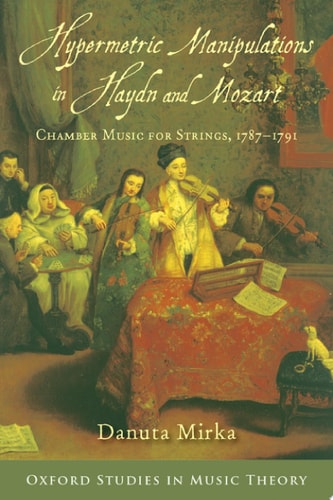
Hypermetric Manipulations in Haydn and Mozart: Chamber Music for Strings, 1787-1791
0
0
As an Amazon Associate and affiliate partner, Menrva Books earns from qualifying purchases. Learn more
Author Description
For the past four decades, the concept of hypermeter has been routinely applied to eighteenth-century music. But was this concept familiar in the eighteenth century? If so, how is it reflected in writings of eighteenth-century music theorists? And how does it relate to their discussion of phrase structure? In this book, a follow-up to the award-winning Metric Manipulations in Haydn and Mozart, author Danuta Mirka unearthes a number of cues that point to eighteenth-century recognition of what today is called hypermeter, and retraces the line of tradition that led from eighteenth-century music theory to the emergence of the modern concept of hypermeter in the twentieth century. Mirka describes the proto-theory of hypermeter developed by German music theorists, recounts the recent history of this concept in American music theory, evaluates contributions made to it by authors working within different theoretical traditions, and introduces a dynamic model of hypermeter which allows the analyst to trace the effect of hypermetric manipulations in real time. This model is applied in analyses of Haydn's and Mozart's chamber music for strings, which shed a new light upon this celebrated repertoire, but the aim of this book goes far beyond an analytical survey of specific compositions. Rather, it is to offer a systematic classification of hypermetrical irregularities in relation to phrase structure and to give a comprehensive account of the ways in which phrase structure and hypermeter were described by eighteenth-century music theorists, conceived by eighteenth-century composers, and perceived by eighteenth-century listeners.
Menrva's Summary
THE THESIS
This book investigates whether the modern concept of hypermeter existed in the eighteenth century and how it relates to the period's own theoretical understanding of phrase structure. Danuta Mirka, a prominent scholar in music theory, utilizes historical treatises and contemporary analytical frameworks to bridge the gap between eighteenth-century proto-theory and modern musicological practice. By examining the works of Haydn and Mozart, she constructs a dynamic model that allows for the real-time tracking of hypermetric irregularities within string chamber music.
THE SCOPE MAP
What You Will Find
- A historical survey of German music theory regarding phrase structure and meter from the late eighteenth century.
- A systematic classification framework for hypermetrical irregularities.
- A dynamic analytical model designed to trace hypermetric effects in real-time performance.
- Detailed case studies of string chamber music compositions by Haydn and Mozart written between 1787 and 1791.
THE AUTHORITY PERSPECTIVE
Experts recognize this work as a significant contribution to the field of music theory, particularly for its rigorous historical contextualization of modern analytical concepts. Readers frequently note the academic density of the prose, which makes it a specialized resource for musicologists and advanced students of music theory.
Page Count:
405
Publication Date:
2021-01-01
Publisher:
Oxford University Press
ISBN-10:
0197548911
ISBN-13:
9780197548912
History
Academic
Music
Humanities
Music theory
Musicology
Chamber
Music Technology
Community Tags
Similar Books