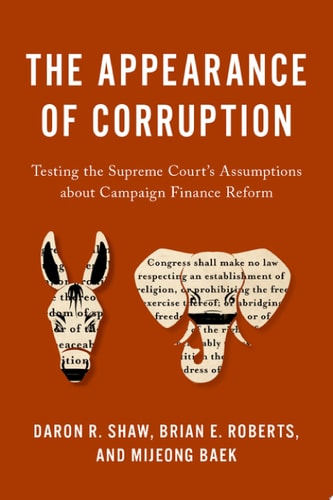
The Appearance of Corruption: Testing the Supreme Court's Assumptions about Campaign Finance Reform
0
0
As an Amazon Associate and affiliate partner, Menrva Books earns from qualifying purchases. Learn more
Author Description
A critical analysis of the connections that the United States Supreme Court has made between campaign finance regulations and voters' behavior.The sanctity of political speech is a key element of the United States Constitution and a cornerstone of the American republic. When the Supreme Court linked political speech to campaign finance in its landmark Buckley v. Valeo (1976) decision, the modern era of campaign finance regulation was born. The decision stated that in order to pass constitutional muster, any laws limiting money in politics must be narrowly tailored and serve a compelling state interest. The lone state interest the Court was willing to entertain was the mitigation of corruption. In order to reach this conclusion, the Court advanced a sophisticated behavioral model that made assumptions about how laws affect voters' opinions and behavior. These assumptions have received surprisingly little attention until now. In The Appearance of Corruption, Daron Shaw, Brian Roberts, and Mijeong Baek analyze the connections that the Court made between campaign finance regulations and voters' behavior. The court argued that an increase in perceived corruption would lower engagement and turnout. Drawing from original survey data and experiments, they confront the question of what happens when the Supreme Court is wrong-and when the foundation of over 40 years of jurisprudence is simply not true. Even with the heightened awareness of campaign finance issues that emerged in the wake of the 2010 Citizens United decision, there is little empirical support for the Court's reasoning that turnout would decline. A rigorous statistical analysis, this is the first work to simultaneously name and test each and every one of the Court's assumptions in the pre- and post-Citizen's United eras. It will also fundamentally reshape how we think about campaign finance regulation's effects on voter behavior.
Menrva's Summary
THE THESIS
Does the empirical evidence regarding voter behavior support the Supreme Court's long-standing assumptions that campaign finance regulations are necessary to prevent corruption and maintain voter turnout? The authors, a team of political scientists, utilize original survey data and experimental methodology to evaluate the behavioral model established in the 1976 Buckley v. Valeo decision. By testing these judicial assumptions against modern data, the authors challenge the foundational logic that has governed American campaign finance jurisprudence for over four decades.
THE SCOPE MAP
What You Will Find
- A comprehensive statistical analysis of voter turnout and perception in the pre
- and post-Citizens United eras.
- A systematic breakdown and empirical testing of every behavioral assumption cited by the Supreme Court regarding money in politics.
- Original survey data and controlled experiments designed to measure the actual impact of campaign finance laws on public engagement.
- An evaluation of the constitutional requirement that campaign finance regulations must serve a compelling state interest to be valid.
THE AUTHORITY PERSPECTIVE
Experts in political science and constitutional law identify this work as a rigorous empirical challenge to established judicial reasoning. Readers frequently note the technical density of the statistical analysis, which serves as a primary resource for scholars examining the intersection of campaign finance regulation and voter behavior.
Page Count:
194
Publication Date:
2021-01-01
Publisher:
Oxford University Press
ISBN-10:
0197548431
ISBN-13:
9780197548431
Elections
Law
Public Policy
United States
Comparative Politics
Government
Professional Career & Trade
Community Tags
Similar Books



Reader Comments
Share Your Thoughts
No comments yet. Be the first to share your thoughts!