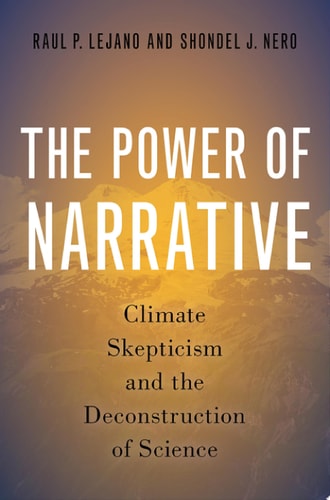
The Power of Narrative: Climate Skepticism and the Deconstruction of Science
0
0
As an Amazon Associate and affiliate partner, Menrva Books earns from qualifying purchases. Learn more
Author Description
There is an ideological war of words waging in America, one that speaks to a new fundamentalism rising not just within the American public, but across other ideologically-torn nations around the globe as well. At its heart is climate skepticism, an ideological watershed that has become a core belief for millions of people despite a large scientific consensus supporting the science of anthropogenic climate change. While many scholars have examined the role of lobbyists and conservative think tanks in fueling the climate skepticism movement, there has not yet been a systematic analysis of why the narrative itself has resonated so powerfully with the public.Pulling from science and technology studies, narrative and discourse theory, and public policy, The Power of Narrative examines the strength of climate skepticism as a story, offering a thoughtful analysis and comparison of anti-climate science narratives over time and across geographic boundaries. This book provides fresh insight into the rhetorical and semantic properties on both sides of the climate change debate that preclude dialogue around climate science, and proposes a means for moving beyond ideological entrenchment through language mediation, further ethnographic study, and research-informed teaching. The Power of Narrative culminates in the revelation of a parallel between narratives about climate skepticism and those in other issue areas (e.g., gun rights, immigration, health crises), exposing a genetic meta-narrative of public distrust and isolation.Ultimately, The Power of Narrative is not a book about climate change in itself: it is, instead, a book about how our society understands and interacts with science, how a social narrative becomes ideology, and how we can move beyond personal and political dogma to arrive at a sense of collective rapprochement.
Menrva's Summary
THE THESIS
This book investigates the rhetorical mechanisms that allow climate skepticism to function as a powerful, resonant narrative despite overwhelming scientific consensus. Authors Raul P. Lejano and Shondel J. Nero utilize a multidisciplinary framework, drawing from science and technology studies, discourse theory, and public policy to analyze how narratives shape public perception. They argue that climate skepticism is not merely a political stance but a manifestation of a broader meta-narrative of distrust that mirrors other polarized social issues.
THE SCOPE MAP
What You Will Find
- Comparative analysis of anti-climate science narratives across different geographic boundaries and time periods.
- Application of narrative and discourse theory to explain the persistence of ideological belief systems.
- Examination of parallel rhetorical structures in other contentious public debates, such as gun rights and immigration.
- Proposed methodologies for language mediation and research-informed teaching to bridge ideological divides.
THE AUTHORITY PERSPECTIVE
Experts in public policy and communication studies identify this work as a significant contribution to understanding the intersection of language and scientific literacy. Readers frequently note the academic density of the prose, which provides a rigorous analytical framework for those studying the sociology of public distrust.
Page Count:
200
Publication Date:
2020-01-01
Publisher:
Oxford University Press
ISBN-10:
0197542123
ISBN-13:
9780197542125
Communication
Environmental
Public Policy
Communications
Climate Change
Sociology
Introduction to Human Communication
Trades & Technology
Community Tags
Similar Books