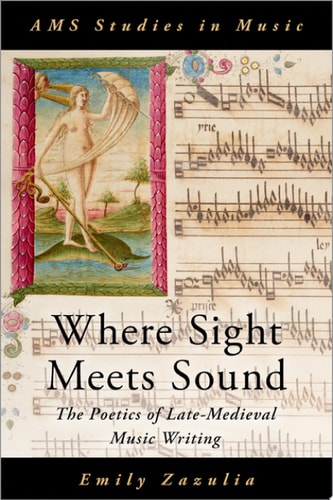
Where Sight Meets Sound: The Poetics of Late-Medieval Music Writing
0
0
As an Amazon Associate and affiliate partner, Menrva Books earns from qualifying purchases. Learn more
Author Description
The main function of western musical notation is incidental: it prescribes and records sound. But during the fourteenth and fifteenth centuries, notation began to take on an aesthetic life all its own. In the early fifteenth century, a musician might be asked to sing a line slower, faster, or starting on a different pitch than what is written. By the end of the century composers had begun tasking singers with solving elaborate puzzles to produce sounds whose relationship to the written notes is anything but obvious. These instructions, which appear by turns unnecessary and confounding, challenge traditional conceptions of music writing that understand notation as an incidental consequence of the desire to record sound. This book explores innovations in late-medieval music writing as well as how modern scholarship on notation has informed—sometimes erroneously—ideas about the premodern era. Drawing on both musical and music-theoretical evidence, this book reframes our understanding of late-medieval musical notation as a system that was innovative, cutting-edge, and dynamic—one that could be used to generate music, not just preserve it.
Menrva's Summary
THE THESIS
This book investigates the shift in late-medieval musical notation from a purely prescriptive tool to an aesthetic and generative system. Emily Zazulia, a scholar specializing in medieval music, examines how fourteenth and fifteenth-century composers utilized notation to create complex puzzles and performance instructions. By analyzing both primary theoretical texts and the musical scores themselves, Zazulia argues that notation served as a creative engine rather than a mere record of sound. The work challenges established musicological narratives that view premodern notation as an incidental or primitive precursor to modern systems.
THE SCOPE MAP
What You Will Find
- Analysis of fourteenth and fifteenth-century musical notation practices.
- Examination of complex performance instructions and musical puzzles.
- Evaluation of modern musicological scholarship regarding premodern notation.
- Synthesis of primary source music theory and actual musical scores.
THE AUTHORITY PERSPECTIVE
Experts recognize this work as a significant contribution to the study of medieval musicology, particularly for its focus on the intellectual complexity of notation. Readers frequently note the academic density of the prose, which is tailored for scholars and advanced students of music history.
Page Count:
344
Publication Date:
2021-01-01
Publisher:
Oxford University Press
ISBN-10:
0197551939
ISBN-13:
9780197551936
History
Music
Music theory
Humanities
Music Technology
Criticism history
Music History
Academic
Community Tags
Similar Books