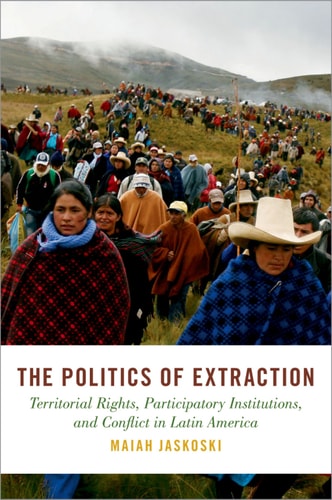
The Politics of Extraction: Territorial Rights, Participatory Institutions, and Conflict in Latin America
0
0
As an Amazon Associate and affiliate partner, Menrva Books earns from qualifying purchases. Learn more
Author Description
Mining and hydrocarbon production in Latin America is high-stakes for extractive firms, communities in resource-rich zones, and states. Amid global commodity price increases and liberal economic policies, the sectors have expanded dramatically in recent decades. This surge has made private investors and governments in the region ever more committed to extraction. It also has increased alarm within local communities, which have organized around the environmental, cultural, and social impacts of mining and hydrocarbons. Moreover, activists have mobilized to demand material benefits, in the forms of royalty distributions and direct company investment in local services and infrastructure. These conflicts take the form of legal battles, large-scale protests, and standoffs that pit communities against companies and the state, and consequently have suspended production, destabilized politics, and expended state security resources. In The Politics of Extraction, Maiah Jaskoski looks at how mobilized communities in Latin America's hydrocarbon and mining regions use participatory institutions to challenge extraction. In some cases, communities act within formal participatory spaces, while in others, they organize "around" or "in reaction to" these institutions, using participatory procedures as focal points in the escalation of conflict. Based on analysis of thirty major extractive conflicts in Bolivia, Colombia, and Peru in the 2000s and 2010s, Jaskoski examines community uses of public hearings built into environmental licensing, state-led prior consultation with native communities affected by large-scale development, and local popular consultations or referenda. She finds that communities select their strategies in response to the specific participatory challenges they confront: the trials of initiating participatory processes, gaining inclusion in participatory events, and, for communities with such access, expressing views about extraction at the participatory stage.
Menrva's Summary
THE THESIS
How do local communities in Latin America utilize participatory institutions to influence or challenge large-scale extractive projects? Maiah Jaskoski, a scholar specializing in Latin American politics and natural resource governance, investigates the intersection of state-led environmental licensing and community resistance. By analyzing the strategic choices made by local actors, the author argues that participatory mechanisms often serve as focal points for conflict escalation rather than mere avenues for consensus-building.
THE SCOPE MAP
What You Will Find
- Comparative analysis of thirty major extractive conflicts across Bolivia, Colombia, and Peru.
- Examination of institutional frameworks including environmental licensing, prior consultation, and local referenda.
- A strategic typology of community responses to state-led participatory processes.
- Evaluation of how commodity price fluctuations and economic policies influence state and corporate behavior.
THE AUTHORITY PERSPECTIVE
Experts in the field of comparative politics and environmental governance recognize this work as a rigorous empirical study of resource-based conflict. Readers frequently note the academic density of the prose and the systematic approach to mapping how local communities navigate complex state bureaucracies.
Page Count:
291
Publication Date:
2022-01-01
Publisher:
Oxford University Press
ISBN-10:
0197568947
ISBN-13:
9780197568941
Energy policy
Public Policy
Sociology
Developing Countries
Community Tags
Similar Books