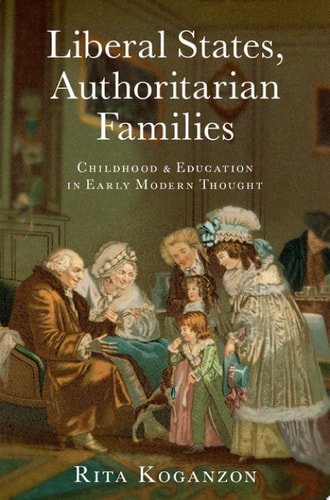
Liberal States, Authoritarian Families: Childhood and Education in Early Modern Thought
0
0
As an Amazon Associate and affiliate partner, Menrva Books earns from qualifying purchases. Learn more
Author Description
Children have posed a longstanding dilemma for liberalism. The authority of adults over children has always been difficult to square with liberalism's foundationally anti-authoritarian premises. But since liberal regimes rely heavily on education, finding a way to square adult authority with children's natural liberty is essential. The logic behind anti-authority childrearing and educational advice is that of congruence; to form good citizens of a liberal democracy, families and schools should resemble miniature, protected democracies so that children can practice liberty and equality in a low-risk environment. This kind of congruence between family and state has very old philosophical roots, surfacing first in ancient Greek and Christian thought and re-emerging in its modern form in the seventeenth century. In Liberal States, Authoritarian Families, Rita Koganzon rejects this impulse, demonstrating that it rests on misunderstanding and neglect of the arguments of early liberals--specifically John Locke and Jean-Jacques Rousseau--about what kind of upbringing and education liberal regimes require. Koganzon shows that not only did early liberals emphatically deny the possibility of congruence between pedagogical and political authority, but they counterintuitively demanded that parents and teachers exercise extensive personal authority over children, while denying the legitimacy of such authority over adults in politics. While contemporary theorists argue that the family should be democratized to reflect the egalitarian ideals of the liberal state, this book argues that the desire for "congruence" between familial and state authority was originally illiberal in origin, advanced by theorists of absolute sovereignty like Bodin and Hobbes. Early liberals opposed modelling the family on the state, even on a democratic, egalitarian state, because they viewed the "authoritarian" family as a necessary educational buttress for children against the new fashionable forms of so
Menrva's Summary
THE THESIS
This book investigates the historical and philosophical tension between the anti-authoritarian foundations of liberal political theory and the necessity of adult authority in the upbringing and education of children. Rita Koganzon, a scholar of political theory, examines the evolution of the "congruence" argument—the idea that families and schools should mirror democratic states—and argues that this model is fundamentally at odds with the original intentions of early liberal thinkers. By analyzing the works of John Locke and Jean-Jacques Rousseau, Koganzon demonstrates that these foundational figures advocated for a distinct separation between pedagogical authority and political governance.
THE SCOPE MAP
What You Will Find
- A historical analysis of the "congruence" theory from ancient Greek and Christian thought to the seventeenth century.
- A critical re-evaluation of the educational philosophies of John Locke and Jean-Jacques Rousseau.
- A comparative study of absolute sovereignty theories, specifically those of Bodin and Hobbes, versus early liberal thought.
- An examination of the contemporary push to democratize the family unit and its potential illiberal origins.
THE AUTHORITY PERSPECTIVE
Scholars in political philosophy recognize this work as a significant challenge to modern assumptions regarding the relationship between the liberal state and the family. The text is noted for its rigorous engagement with primary source material and its ability to reframe long-standing debates about pedagogical authority.
Page Count:
218
Publication Date:
2021-01-01
Publisher:
Oxford University Press
ISBN-10:
0197568823
ISBN-13:
9780197568828
History
Philosophy
Special Topics
Education
Liberalism
Community Tags
Similar Books