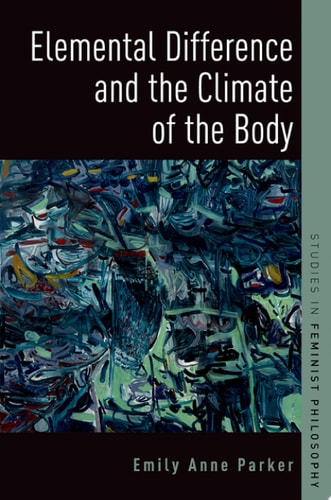
Elemental Difference and the Climate of the Body (Studies in Feminist Philosophy)
0
0
As an Amazon Associate and affiliate partner, Menrva Books earns from qualifying purchases. Learn more
Author Description
In nineteenth-century Europe, differences among human bodies were understood to be matters of scientific classification. At the height of scientific acceptance, it was unthinkable that race or sex or diagnosis or indigence were invention. Today, however, differences among human bodies are understood as matters of social construction. The philosophy of social construction understands differences among humans to be matters of human imposition. Social constructionism's way of understanding the origin of differences among humans is so well-established as to have no currently viable alternatives, even among new materialists, social constructionism's most ardent critics. This book argues that new materialists and social constructionists share a distinction between the political and the ecological. Emily Anne Parker centers her argument on the philosophical concept of the polis, according to which there is one complete human form. It is this form that is to blame for our current political and ecological crisis. Political hierarchies and ecological crises are often considered to be two different problems: for example, many speak of parallel problems, climate change and racial injustice. Parker argues that these are not parallel crises so much as one problem: the polis. The philosophy of the polis asserts that there is one complete human body, and that body is meant to govern all other things. In that sense there are not two crises, but instead one concern: to perceive the ways in which this tradition of the polis constrains the present. Elemental difference in the polis is appreciated in the fact that "empirical bodily non-identity," an Aristotelian concept, can be called upon to elevate one group of bodies among the rest. Parker builds from Sylvia Wynter, who argues that the very idea of empirical bodily non-identity begins with the modern science of racial anatomy, or what Wynter calls biocentrism. Parker argues that biocentrism is a feature of the polis, according to whi
Menrva's Summary
THE THESIS
This book investigates whether the modern political and ecological crises are fundamentally linked by the philosophical tradition of the polis and its insistence on a singular, dominant human form. Emily Anne Parker, a scholar in feminist philosophy, challenges the prevailing social constructionist framework by examining how new materialist perspectives and traditional political theory converge to create hierarchies. By synthesizing Aristotelian concepts with the work of Sylvia Wynter, Parker argues that the modern obsession with biocentrism and empirical bodily non-identity serves to justify both social inequality and environmental degradation.
THE SCOPE MAP
What You Will Find
- An analysis of the philosophical concept of the polis and its historical influence on human classification.
- A critique of the distinction between political justice and ecological sustainability.
- An examination of biocentrism as a mechanism for racial and sexual hierarchy.
- A synthesis of new materialist theory and feminist philosophy to reframe the current climate crisis.
THE AUTHORITY PERSPECTIVE
Experts in feminist and environmental philosophy identify this work as a rigorous intervention into contemporary debates regarding social constructionism. Readers frequently note the high level of academic density and the sophisticated synthesis of historical and modern philosophical frameworks.
Page Count:
320
Publication Date:
2021-01-01
Publisher:
Oxford University Press
ISBN-10:
0197575102
ISBN-13:
9780197575109
Philosophy
Public Policy
Political Philosophy
Human ecology
Womens Studies
Feminist Philosophy
Environmental Philosophy
Social Theory
Feminist Theory
Community Tags
Similar Books