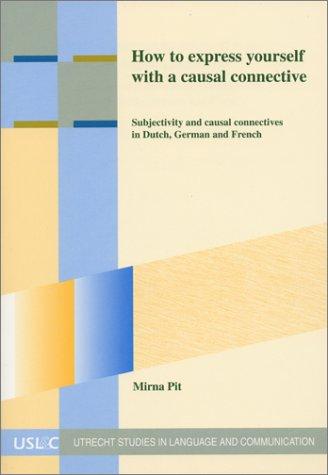
How To Express Yourself With A Causal Connective
0
0
As an Amazon Associate and affiliate partner, Menrva Books earns from qualifying purchases. Learn more
Author Description
The Dutch, German and French languages display a variety of regularly used connectives all of which introduce causes, arguments or reasons, such as Dutch omdat, want and aangezien, German weil, denn and da, and French parce que, car and puisque. Why should languages have different connectives to express the notion of backward causality? The central argument developed in this book is that different connectives express different degrees of subjectivity. In a series of corpus analyses it is shown that the degree of subjectivity of the main participant involved in the causal relation strongly predicts the occurrence of one or another connective. Hence, language users have at their disposal connectives of varying degrees of subjectivity. In an analysis of judiciary sentences, it is revealed that speakers are actually sensitive of this semantic distinction, and sometimes even exploit it for their communicative purposes: in order to conceal their subjective involvement, judges prefer objective over subjective connectives. This volume makes a contribution to the study of language in use, by applying empirical methods to authentic language data. It will be of interest to anyone concerned with discourse coherence, perspective and subjectivity, corpus linguistics and cross-linguistic analyses.
Menrva's Summary
THE THESIS
This book investigates why languages employ distinct connectives to express backward causality, arguing that these differences correlate with varying degrees of subjectivity. The author, Mirna Pit, utilizes corpus analyses to demonstrate how the subjectivity of participants in a causal relation predicts the choice of connective. This research reveals that language users possess connectives with differing levels of subjectivity, which are sensitive to semantic distinctions and sometimes exploited for communicative advantage, as seen in judiciary sentences where judges prefer objective connectives to mask their involvement. The volume applies empirical methods to authentic language data, contributing to the study of language in use.
THE SCOPE MAP
- Analysis of causal connectives in Dutch, German, and French (e.g., Dutch 'omdat', 'want', 'aangezien'; German 'weil', 'denn', 'da'; French 'parce que', 'car', 'puisque').
- Corpus analyses demonstrating the correlation between participant subjectivity and connective choice.
- Examination of how language users distinguish and utilize connectives of varying subjectivity.
- Case study of judiciary sentences to illustrate the exploitation of semantic distinctions for communicative purposes.
- Application of empirical methods to authentic language data.
- Contribution to the study of discourse coherence, perspective, and subjectivity.
- Cross-linguistic analysis of causal expressions.
THE AUTHORITY PERSPECTIVE
This volume offers a detailed linguistic analysis of causal connectives, focusing on the semantic distinction of subjectivity. The author's application of corpus linguistics and empirical methods to authentic data provides a robust framework for understanding how different languages express backward causality. The study's findings suggest that speakers are attuned to these subtle semantic differences and may strategically employ them, particularly in formal contexts like legal proceedings. It is positioned to be of interest to scholars and students of discourse, semantics, and cross-linguistic studies.
Page Count:
366
Publication Date:
2003-01-01
ISBN-10:
9042008563
ISBN-13:
9789042008564
Literary Fiction
Non-Fiction
Subjectivity
Linguistics
Corpus linguistics
Semantics
Discourse Analysis
Community Tags
Similar Books