Form and Function of Causation
0
0
As an Amazon Associate and affiliate partner, Menrva Books earns from qualifying purchases. Learn more
Author Description
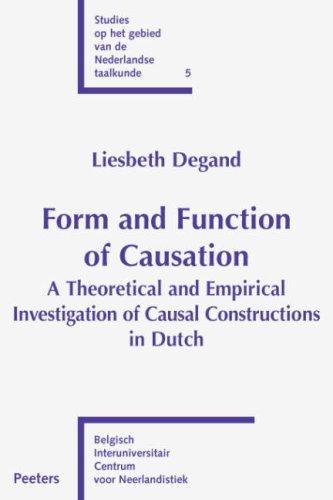
The aim of this study is to provide a unified functional description of a number of causal constructions in Dutch: the connectives omdat, want, doordat, the prepositions door, vanwege, wegens, and the auxiliaries doen and laten. Given the observation that the various causal alternatives are not in free variation in discourse, the author hypothesises that this distribution must be constrained and that it should be possible to identify some of the constraints that play a role in the selection of these causal forms. To reach this goal, Degand proposes to make use of a multifunctional theory of language - Systemic Functional Linguistics - in combination with numerous corpus analyses. This approach to language appeared to be particularly relevant, because it enables to give an explicit account of aspects of language that fall out of the traditional scope of linguistic description, namely accounts of genre, register, discourse semantics, etc. while the corpus analyses provide a solid empirical basis for the theoretical descriptions.
Menrva's Summary
THE THESIS
This study investigates the functional distribution of causal constructions in Dutch. The author, Liesbeth Degand, aims to provide a unified functional description of various causal connectives, prepositions, and auxiliaries, including 'omdat', 'want', 'doordat', 'door', 'vanwege', 'wegens', 'doen', and 'laten'. By hypothesizing that the selection of these forms is constrained by discourse factors, Degand utilizes Systemic Functional Linguistics and corpus analyses to identify these constraints. This approach allows for an explicit account of aspects like genre, register, and discourse semantics, supported by empirical data from corpus analyses.
THE SCOPE MAP
- Analysis of Dutch causal constructions: omdat, want, doordat, door, vanwege, wegens, doen, laten.
- Application of Systemic Functional Linguistics for a multifunctional language theory.
- Extensive corpus analyses to provide an empirical basis for theoretical descriptions.
- Investigation into discourse constraints governing the selection of causal forms.
- Exploration of aspects beyond traditional linguistic scope, such as genre and register.
- Focus on discourse semantics and the functional description of language use.
THE AUTHORITY PERSPECTIVE
This work offers a detailed linguistic analysis of Dutch causal constructions, employing Systemic Functional Linguistics and corpus data. It aims to provide a rigorous, empirically grounded account of how and why specific causal forms are selected in discourse. The methodology suggests a textually focused, analytical approach suitable for linguists and advanced Dutch language students.
Page Count:
218
Publication Date:
2000-01-01
ISBN-10:
9042909293
ISBN-13:
9789042909298
Non-Fiction
Literary Fiction
Grammar
Linguistics
Dutch Language
Community Tags
Similar Books