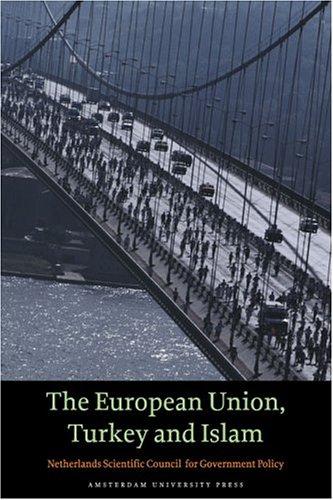
The European Union, Turkey and Islam
0
0
As an Amazon Associate and affiliate partner, Menrva Books earns from qualifying purchases. Learn more
Author Description
Does the fact that the majority of Turkey's population is Muslim form a hindrance to its EU membership? According to a recent policy advice by the Netherlands Scientific Council for Government Policy (WRR), the answer is an adamant 'no'. Why is this issue of Turkish Islam relevant? After all, Turkey should not be judged by standards other than the Copenhagen criteria. The answer is that the public debate outside 'Brussels' will not be limited to these official criteria. Many people in Europe are worried about Turkey's 'Islam factor'. They believe that Muslims are (potentially violent) fundamentalists who want to establish a theocracy. By explicitly examining the role of Turkish Islam and Muslims in Turkey, the WRR wants to contribute to a well-informed European public debate on Turkey's accession.
Menrva's Summary
THE THESIS
The European Union's potential membership of Turkey is complicated by the perception of Islam as a barrier, yet this policy advice argues that this is not an inherent obstacle. The Netherlands Scientific Council for Government Policy (WRR) addresses the public concern regarding Turkey's 'Islam factor,' which often stems from misconceptions about Muslims and theocracy. By analyzing Turkish Islam and the role of Muslims within Turkey, the WRR aims to foster a more informed public discourse beyond the official Copenhagen criteria. This analysis seeks to counter unfounded fears and provide a nuanced perspective on Turkey's accession prospects.
THE SCOPE MAP
- Analysis of the role of Islam in Turkish society and politics.
- Examination of public perceptions and debates surrounding Turkey's EU membership in Europe.
- Assessment of whether the Muslim majority in Turkey poses a hindrance to EU accession.
- Discussion of the Copenhagen criteria in relation to Turkey's potential membership.
- Contribution to a well-informed public debate on Turkey's accession process.
THE AUTHORITY PERSPECTIVE
The Netherlands Scientific Council for Government Policy's advice directly addresses a significant point of contention in the public debate surrounding Turkey's EU accession. By focusing on the 'Islam factor,' it seeks to provide a factual basis for discussions often clouded by prejudice and misinformation. The council's aim is to inform the European public and policymakers, suggesting that the religious composition of Turkey should not be an automatic disqualifier. This perspective challenges simplistic narratives and advocates for a more nuanced understanding of Turkey's relationship with the EU.
Page Count:
192
Publication Date:
2004-01-01
ISBN-10:
9053567127
ISBN-13:
9789053567128
Religion
Politics
Non-Fiction
Islam
Sociology
International relations
European Union
Community Tags
Similar Books