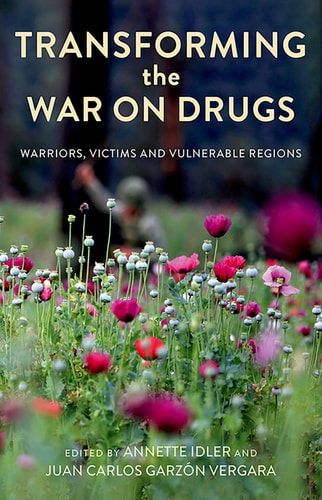
Transforming the War on Drugs: Warriors, Victims and Vulnerable Regions
0
0
As an Amazon Associate and affiliate partner, Menrva Books earns from qualifying purchases. Learn more
Author Description
The war on drugs has failed, but consensus in the international drug policy debate on the way forward is missing. Amidst this moment of uncertainty, militarized lenses on the global illicit drug problem continue to neglect the complexity of the causes and consequences that this war is intended to defend or defeat. Challenging conventional thinking in defense and security sectors, Transforming the War on Drugs constitutes the first comprehensive and systematic effort to theoretically, conceptually, and empirically investigate the impacts of the war on drugs.The contributors trace the consequences of the war on drugs across vulnerable regions, including South America and Central America, West Africa, the Middle East and the Golden Crescent, the Golden Triangle, and Russia. It demonstrates that these consequences are 'glocal'. The war's local impacts on human rights, security, development, and public health are interdependent with transnational illicit flows. The book further reveals how these impacts have influenced the positions of governments across these regions, with significant ramifications for the international drug control regime. Crucially, it shows that, at a time when global order is in flux, critically evaluating the regime's securitization through the war on drugs provides key insights into other global governance realms.
Menrva's Summary
THE THESIS
This book investigates the systemic failures and global consequences of the war on drugs, questioning the efficacy of militarized security policies in addressing illicit drug trade. Annette Idler and Juan Carlos Garzón Vergara, both established scholars in security and conflict studies, synthesize empirical data from diverse geopolitical regions to challenge conventional defense-oriented frameworks. They argue that the current international drug control regime ignores the complex, interdependent nature of local human rights issues and transnational illicit flows, necessitating a shift toward more nuanced governance strategies.
THE SCOPE MAP
What You Will Find
- Comparative analysis of drug policy impacts across South America, Central America, West Africa, the Middle East, and Russia.
- A theoretical framework defining the 'glocal' nature of illicit drug flows and their influence on state governance.
- Empirical evidence linking militarized drug enforcement to broader failures in public health, development, and human rights.
- Critical evaluation of the securitization of international drug control and its broader implications for global order.
THE AUTHORITY PERSPECTIVE
Experts identify this work as a significant contribution to the field of international security, noting its systematic approach to a traditionally fragmented policy debate. Readers frequently highlight the academic density of the prose and the breadth of the regional case studies as essential for understanding modern drug policy challenges.
Page Count:
320
Publication Date:
2021-12-01
Publisher:
Oxford University Press
ISBN-10:
0197604358
ISBN-13:
9780197604359
Sociology
International relations
Criminology
National security
Public Policy
Community Tags
Similar Books