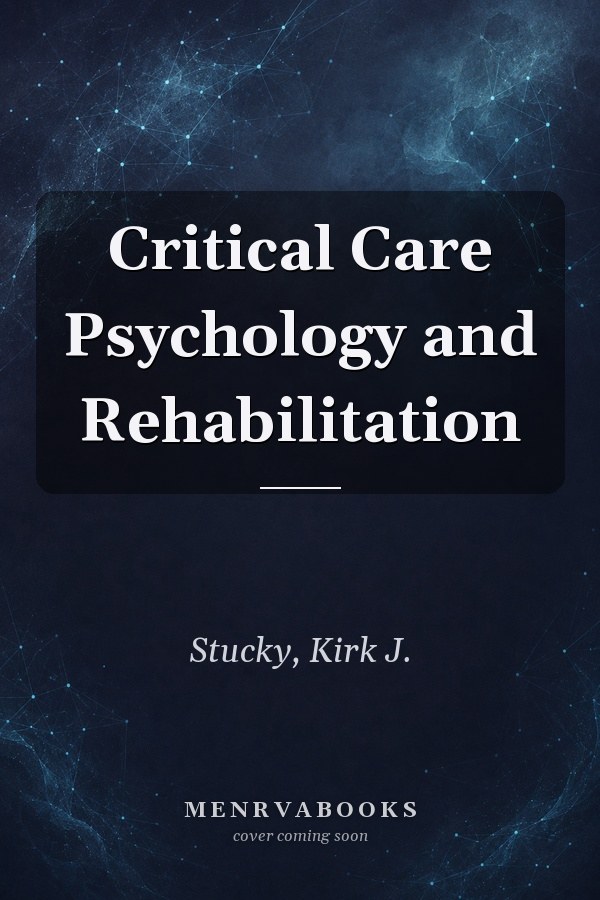
Critical Care Psychology and Rehabilitation
0
0
As an Amazon Associate and affiliate partner, Menrva Books earns from qualifying purchases. Learn more
Author Description
When Contemplating The Broad Field Of Critical Care And All Of Its Complexities, Rehabilitation And Psychology Practice Is Not Likely Among The Top Ten Services That Clinicians, Patients, Or The Public Think Of, And Rightly So. The Vast Majority Of Patients Who Require Intensive Care Arrive At Death's Door, And Many Linger In A Limbo-like Space Somewhere Between Life And The Afterlife. The Primary Focus At This Juncture Is Often On Pressing Matters Such As Reestablishing And Stabilizing Basic Bodily Functions, Optimizing Life-saving Machine Settings, And Deciding Who Does And Does Not Need Additional, Urgent Interventions. Still, Just Beneath The Surface Of This Fascinating, Multilayered Environment, The Need For Psychologists And Rehabilitation-oriented Clinicians Is Everywhere, In Large Part Because Intensive Care Stands Among The Most Emotionally Intense And Physically Taxing Hospital-based Settings For Everyone Involved - Patients, Families, Caregivers, And Staff Alike. Despite This, Recognition That Psychologists And Rehabilitation-oriented Professionals Could And Should Be More Integrated Within The Critical Care Team Is Uncommon. In Fact, It Can Be Argued That Some European Countries Are Ahead Of The United States (us) In This Regard (agarwala, Ahmed, & Patil, 2011; Andreoli, Novaes, Karam, & Knobel, 2001; Jackson & Jutte, 2016; Peris Et Al., 2011; Sukantarat, Greer, Brett, & Williamson, 2007; Tan, Brett, & Stokes, 2009; Van Den Born-van Zanten, Dongelmans, Dettling-ihnenfeldt, Vink, & Van Der Schaaf, 2016). Fortunately, There Are Growing Integrative Trends In The Us. In 2010, A Conference Was Convened By The Society Of Critical Care Medicine (sccm) With Broad Goals To Inform Stakeholders About The Multiple Long-term Consequences Of Critical Illness (e.g., Postintensive Care Syndrome [pics]) And Initiate--
Menrva's Summary
THE THESIS
This text investigates the critical necessity of integrating psychological and rehabilitation services into the standard multidisciplinary critical care environment. The authors, Jennifer Stevenson Jutte and Kirk J. Stucky, leverage clinical research and international comparative data to argue that the current focus on acute physiological stabilization often neglects the long-term psychological and functional recovery of patients. They present a framework for expanding the role of mental health and rehabilitation professionals within intensive care units to address the complex needs of patients, families, and medical staff.
THE SCOPE MAP
What You Will Find
- Analysis of Post-Intensive Care Syndrome (PICS) and its long-term impacts on patient outcomes.
- Comparative study of international healthcare models regarding psychological integration in critical care.
- Methodologies for interdisciplinary collaboration between psychologists, rehabilitation therapists, and critical care physicians.
- Evidence-based strategies for managing the emotional and physical stressors inherent in intensive care environments.
THE AUTHORITY PERSPECTIVE
Experts identify this work as a significant contribution to the evolving field of critical care medicine, particularly regarding the holistic management of patient recovery. Readers frequently note the clinical density of the text, which serves as a practical resource for practitioners seeking to implement integrated care models in hospital settings.
Page Count:
0
Publication Date:
2022-01-01
Publisher:
Oxford University Press,
ISBN-10:
0197604196
ISBN-13:
9780197604199
Psychology
Critical Care
Healthcare
Rehabilitation
Medical
Community Tags
Similar Books