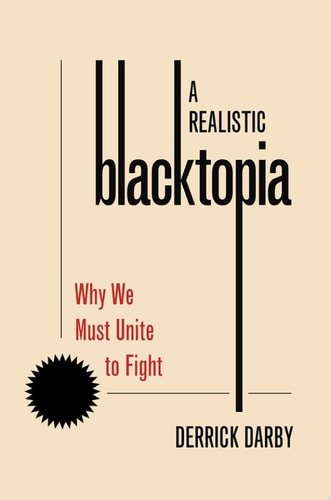
A Realistic Blacktopia: Why We Must Unite To Fight
0
0
As an Amazon Associate and affiliate partner, Menrva Books earns from qualifying purchases. Learn more
Author Description
The United States is dogged by racism and racial disparities in income, wealth, health, education, and criminal justice. Philosophers disagree on what kind of politics is needed to address this problem. Do we pursue race-specific remedies to undo racism or do we assume the permanence of racism and opt for non-race-specific remedies in pursuit of a more egalitarian society? Paradoxically, the way to make racial progress in racist America is to downplay race.In A Realistic Blacktopia, political philosopher Derrick Darby challenges the "small tent" approach by examining U.S. Supreme Court cases on education and voting rights arguing that they hold general lessons about the limits of racial politics. Securing racial justice in racist America calls for "big tent" remedies, and Darby argues that pursuing non-race-specific remedies with maximal democratic inclusion is a necessary strategy for mitigating racial inequality and achieving racial justice.A Realistic Blacktopia offers clarity on how racism persists, contrary to claims that America is a postracial society. Explaining why the myth of postracialism cannot be ignored in crafting remedies for racial inequality, Darby supplies a principled pragmatic proposal for achieving racial justice. Drawing on the political thought of Martin Luther King Jr., W. E. B. Du Bois, and the black radical tradition, Darby also explains why achieving racial justice requires inclusive democracy.
Menrva's Summary
THE THESIS
How can a society effectively address systemic racial inequality while navigating the persistent reality of racism? Political philosopher Derrick Darby examines the limitations of current racial politics, arguing that the pursuit of race-specific remedies often fails to achieve egalitarian goals. By synthesizing the political thought of figures like Martin Luther King Jr. and W. E. B. Du Bois, Darby proposes a 'big tent' strategy that prioritizes non-race-specific remedies and maximal democratic inclusion to mitigate inequality.
THE SCOPE MAP
What You Will Find
- Analysis of U.S. Supreme Court jurisprudence regarding education and voting rights.
- A critique of 'small tent' versus 'big tent' political strategies for racial progress.
- Theoretical frameworks derived from the black radical tradition and historical political thought.
- A pragmatic proposal for achieving racial justice within a democratic structure.
THE AUTHORITY PERSPECTIVE
Scholars and political theorists recognize this work as a significant contribution to the discourse on racial justice and democratic theory. Readers frequently note the clarity with which Darby navigates complex philosophical arguments regarding postracialism and institutional reform.
Page Count:
320
Publication Date:
2022-12-11
Publisher:
Oxford University Press
ISBN-10:
0197622127
ISBN-13:
9780197622124
Philosophy
Social justice
Race Relations
Sociology
United States
Community Tags
Similar Books