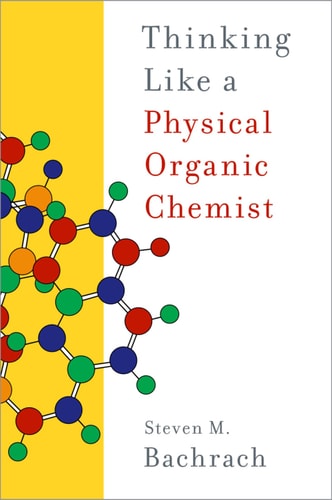
Thinking Like a Physical Organic Chemist
0
0
As an Amazon Associate and affiliate partner, Menrva Books earns from qualifying purchases. Learn more
Author Description
Physical organic chemistry is a modern scientific subdiscipline whose reach is pervasive throughout chemistry, underpinning every academic and industrial synthetic process. All current organic chemistry textbooks rest upon the foundations of physical organic chemistry, and all of them rely on the concept of reaction mechanism as the means for understanding organic reactions. Yet many outside of the discipline either fear the topic or know nothing about it at all. The perceived difficulty of the subject of organic chemistry often prevents consideration of how the methods of organic chemists, their process of asking questions, devising tests, and building models, can be translated into other disciplines. In Thinking Like a Physical Organic Chemist, Professor Steven M. Bachrach uses analogies and colorful examples to provide experts and nonexperts alike with an alternative way of thinking about organic chemistry. He highlights a number of reaction mechanisms, walking through the important experiments that they rest upon, with an emphasis on the rules and logic systems that organic chemists have built to understand and predict reaction outcomes.
Menrva's Summary
THE THESIS
This book investigates how the fundamental logic, experimental methods, and model-building processes of physical organic chemistry can be applied to broader scientific inquiry. Professor Steven M. Bachrach, an expert in computational chemistry, utilizes his academic background to demystify the discipline for both specialists and those outside the field. By focusing on reaction mechanisms and the underlying rules of chemical behavior, he provides a framework for translating the analytical rigor of organic chemistry into other scientific domains.
THE SCOPE MAP
What You Will Find
- Analysis of fundamental reaction mechanisms and the experiments that support them
- Methodologies for asking scientific questions and devising empirical tests
- Frameworks for building predictive models in chemical research
- Analogies and illustrative examples designed to bridge the gap between expert and non-expert understanding
THE AUTHORITY PERSPECTIVE
Experts recognize this text as a valuable bridge for students and professionals seeking to understand the logical foundations of chemical reactivity. Readers frequently note that the prose successfully simplifies complex theoretical concepts without sacrificing the technical accuracy required for academic study.
Page Count:
256
Publication Date:
2023-01-01
Publisher:
Oxford University Press
ISBN-10:
0197640397
ISBN-13:
9780197640395
History
Science
Academic
Education
Chemistry
Organic chemistry
Earth Sciences
Community Tags
Similar Books