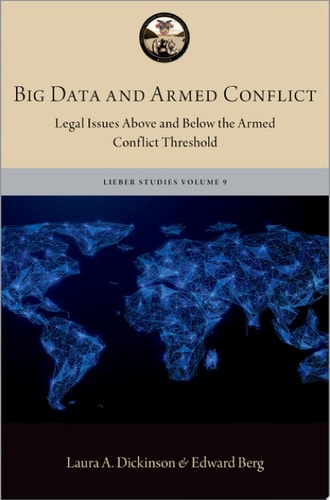
Big Data and Armed Conflict: Legal Issues Above and Below the Armed Conflict Threshold
0
0
As an Amazon Associate and affiliate partner, Menrva Books earns from qualifying purchases. Learn more
Author Description
This book provides a pathbreaking attempt both to define the important legal questions related to the growing use of “big data” in extraterritorial military operations, and to begin to provide some answers. Big data, meaning the troves of data generated by new information technologies and the advanced analytics used to process that data, is radically reshaping the modern battlefield. Like many new military technologies and capabilities, the myriad uses of big data present broad questions about how to translate existing rules and principles embedded in multiple bodies of law to these new contexts, both within armed conflict, as part of adversarial activities below the armed conflict threshold, and in a range of related operations that increasingly use, deploy, and target such data. These questions extend beyond the role of big data within weapons systems and other military capabilities to questions about the nature of civilian harm, scope of individual rights, atrocity investigation, and humanitarian relief.The chapters in this book comprise the first initiative to grapple with a wide swath of these questions including whether, and how, jus ad bellum, international humanitarian law, international human rights law, and international criminal law might apply to operations involving big data. At the same time, because big data is so transformative, the uses of such data provoke deeper questions about the law itself, exposing gaps and interpretive ambiguities in existing legal frameworks that generate critiques of those frameworks as inadequate. Accordingly, while big data holds enormous promise, it also has the potential to disrupt modern warfare and the rule of law itself. This book confronts these issues directly, offers a range of approaches, and suggests an initial roadmap for scholars and practitioners alike.
Menrva's Summary
THE THESIS
This book investigates the complex intersection of big data analytics and international legal frameworks governing military operations and adversarial activities. The author, Berg, examines how the rapid integration of advanced data processing into modern warfare challenges established norms within international humanitarian law, human rights law, and criminal law. By analyzing both the tactical deployment of data and the broader implications for the rule of law, the text provides a structured roadmap for addressing the legal ambiguities created by these emerging technologies.
THE SCOPE MAP
What You Will Find
- Analysis of jus ad bellum and international humanitarian law applications to data-driven military operations.
- Examination of legal gaps regarding civilian harm, individual rights, and atrocity investigations.
- Discussion of adversarial activities occurring below the traditional threshold of armed conflict.
- Evaluation of the transformative impact of big data on the global rule of law.
THE AUTHORITY PERSPECTIVE
Experts identify this work as a foundational text for understanding the legal challenges posed by digital transformation in modern conflict. Readers frequently note the academic density of the prose, which serves as a primary resource for legal scholars and military practitioners navigating these evolving regulatory landscapes.
Page Count:
392
Publication Date:
2024-01-01
Publisher:
Oxford University Press
ISBN-10:
0197668615
ISBN-13:
9780197668610
Military
Technology
International relations
Law
Criminal Law
Community Tags
Similar Books