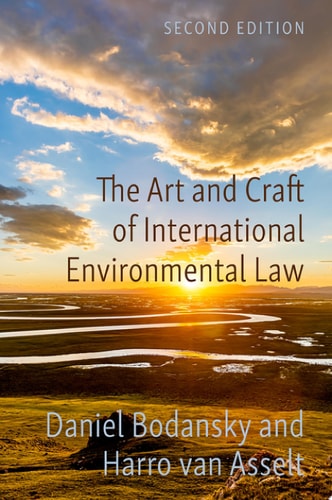
The Art and Craft of International Environmental Law
0
0
As an Amazon Associate and affiliate partner, Menrva Books earns from qualifying purchases. Learn more
Author Description
In countless ways we are affected by international environmental norms: some social, others legal; some quite general, others very specific. For example, the norms limiting the refrigerants used in air conditioners have been agreed upon in legal form internationally, and are mandated and enforced by national governments. The sustainable fishery and forestry standards used by Carrefour and Ikea were developed more informally by environmental groups and businesses, and are applied to producers through supply-chain contracts, without any government involvement. The reluctance to eat tuna fish or own elephant ivory reflects more general social norms, disseminated through education and culture.How and why do these norms arise? In what ways do they affect behavior? Do they change what states and individuals actually do and, if so, why? How effective are they in solving international environmental problems? In the second edition of The Art and Craft of International Environmental Law, Daniel Bodansky and Harro van Asselt explore these and other questions.Revisions cover the numerous developments spanning the 13 years since the first edition was published. New chapters address the growing role of environmental NGOs and the increasingly complex architecture of environmental law involving multiple institutions, levels of governance, and actors. Recent research has been incorporated on treaty design and policy implementation and effectiveness, and greater attention has been given to the role of the judiciary in standard-setting, implementation, and enforcement.A sophisticated yet highly readable introduction to how international environmental law works (and sometimes doesn't work), this book is essential reading for a wide audience.
Menrva's Summary
THE THESIS
This book investigates the mechanisms through which international environmental norms emerge, function, and influence state and individual behavior. Daniel Bodansky and Harro van Asselt leverage their extensive expertise in international law and environmental policy to analyze the complex architecture of global governance. By examining the interplay between formal legal treaties and informal social standards, the authors provide a comprehensive framework for understanding how environmental problems are addressed on a global scale. The text synthesizes recent research on treaty design, judicial roles, and policy implementation to explain why certain environmental regulations succeed while others fail.
THE SCOPE MAP
What You Will Find
- Analysis of the evolving roles of environmental NGOs and non-state actors in global governance.
- Examination of the multi-level architecture of environmental law, spanning local to international institutions.
- Evaluation of treaty design, policy implementation, and the effectiveness of enforcement mechanisms.
- Discussion of the judiciary's increasing influence in standard-setting and legal compliance.
THE AUTHORITY PERSPECTIVE
Experts recognize this work as a foundational text for understanding the practical application of international environmental law. Readers frequently note the clarity of the prose, which makes complex legal and political concepts accessible to both students and practitioners in the field.
Page Count:
432
Publication Date:
2024-01-01
Publisher:
Oxford University Press
ISBN-10:
0197672361
ISBN-13:
9780197672365
International relations
Schools & Teaching
Law
Public Policy
Community Tags
Similar Books