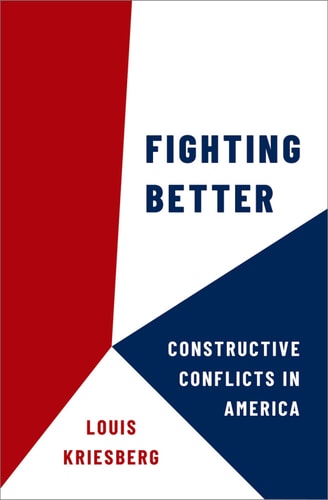
Fighting Better: Constructive Conflicts in America
0
0
As an Amazon Associate and affiliate partner, Menrva Books earns from qualifying purchases. Learn more
Author Description
The people in the United States are experiencing an extreme degree of division, political partisanship, and civic disorder. Destructive fights are waged about matters such as misinformation, voting rights, school curriculum, government spending, and personal privacy. How can these distressing circumstances be overcome? More specifically, what makes the difference between conflicts that result in progress versus those that further contribute to a greatly polarized, extremely unequal, and distressed society?In Fighting Better, Louis Kriesberg argues that the crises confronting the US presently are the result of changes in dynamics along three societal dimensions: class, status, and power. Those changes were brought about to a great degree by people waging conflicts constructively, destructively, or avoiding overt conflicts altogether. Assessing major domestic conflicts in the United States since 1945, Kriesberg evaluates how well conflicts were waged in terms of advancing justice, liberty, and equal opportunity for all Americans. Moreover, he offers ideas for how some of those fights might have been waged more effectively and with longer-term benefits, connecting current US crises to past mistakes. In doing so, Kriesberg deepens our understanding of how the way conflicts are waged can help to reduce inequities in class, power, and status, particularly with regard to gender and race.
Menrva's Summary
THE THESIS
This book investigates how the methods used to conduct social and political conflicts in the United States determine whether those struggles lead to societal progress or further polarization. Louis Kriesberg, a scholar of conflict resolution, utilizes a historical framework to analyze domestic tensions since 1945. He argues that the current state of civic disorder stems from shifts in class, status, and power dynamics. By evaluating past conflicts, the author provides a diagnostic tool for understanding how constructive engagement can mitigate systemic inequities.
THE SCOPE MAP
What You Will Find
- Analysis of societal dimensions including class, status, and power dynamics.
- Evaluation of major domestic conflicts in the United States from 1945 to the present.
- Assessment of how conflict strategies impact justice, liberty, and equal opportunity.
- Frameworks for transitioning from destructive to constructive conflict resolution.
THE AUTHORITY PERSPECTIVE
Experts recognize this work as a significant contribution to the study of American political polarization and social change. Readers frequently note the analytical depth Kriesberg brings to the intersection of historical context and modern conflict resolution theory.
Page Count:
336
Publication Date:
2022-01-01
Publisher:
Oxford University Press
ISBN-10:
0197674828
ISBN-13:
9780197674826
History
Conflict Resolution
Sociology
Technology & Engineering
Democracy history
Democracy
Local government
Trades & Technology
Social Classes
American Studies
Community Tags
Similar Books