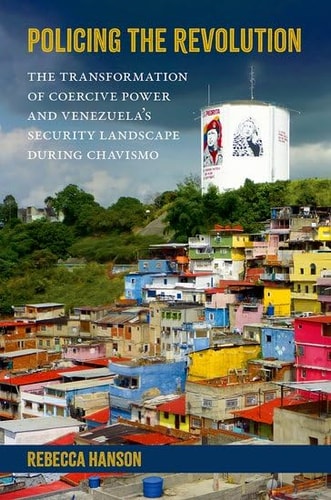
Policing the Revolution: The Transformation of Coercive Power and Venezuela's Security Landscape During Chavismo (Global and Comparative Ethnography)
0
0
As an Amazon Associate and affiliate partner, Menrva Books earns from qualifying purchases. Learn more
Author Description
Since the mid-2000s Venezuela has been ranked one of the most violent countries in the world as homicides and police violence skyrocketed. Much has been written about the country's turn to Chavismo but scholarship has ignored what will perhaps be the revolution's most important legacy: how Chavista policies transformed coercive power and the security landscape.In Policing the Revolution, Rebecca Hanson provides the first in-depth analysis of policing and security policies during the Bolivarian Revolution in Venezuela, focusing on the experiences of three groups: police officers, police reformers, and residents of neighborhoods most affected by violence. Drawing on ethnographic, interview, and survey research collected over ten years, she analyzes how security policies within the context of the pink tide and later turn to authoritarianism contributed to the expansion of lateral violence and the pluralization of non-state violent actors. Far from the always-already authoritarian project proposed by many scholars and pundits, Hanson shows that the Bolivarian Revolution was defined by highly contested and contrasting visions of security that resulted in a fragmented and inconsistent ordering of state and society. Moreover, by pairing the vantage point of street-level police officers with that of ordinary barrio residents, she provides a unique analysis of how insecurity during revolution was experienced "from below."Rethinking the relationship between revolution, violence, and state-building, this book is essential reading to understand how and why violence increased so dramatically in Venezuela in the twenty-first century.
Menrva's Summary
THE THESIS
This book investigates how the policies of the Bolivarian Revolution in Venezuela fundamentally reshaped the nation's security landscape and the nature of coercive state power. Rebecca Hanson, a researcher specializing in Latin American security, utilizes a decade of ethnographic fieldwork, interviews, and survey data to challenge the narrative that Venezuela's security crisis was a predetermined outcome of authoritarianism. Instead, she argues that the revolution was characterized by competing, fragmented visions of security that ultimately led to increased violence and the proliferation of non-state armed actors.
THE SCOPE MAP
What You Will Find
- Longitudinal ethnographic research covering the period from the mid-2000s through the rise of authoritarianism.
- Comparative analysis of perspectives from street-level police officers, institutional reformers, and barrio residents.
- Examination of the pluralization of non-state violent actors and the expansion of lateral violence.
- A framework for understanding the intersection of revolutionary state-building and daily experiences of insecurity.
THE AUTHORITY PERSPECTIVE
Experts recognize this work as a significant contribution to the study of state-building and violence in Latin America. Readers frequently note the depth of the ethnographic research, which provides a necessary bottom-up perspective on complex political transformations.
Page Count:
320
Publication Date:
2025-02-04
Publisher:
Oxford University Press
ISBN-10:
0197680828
ISBN-13:
9780197680827
History
Philosophy
Politics
Specific Topics
Law Enforcement
Criminology
Criminal Law
Sociology
Community Tags
Similar Books