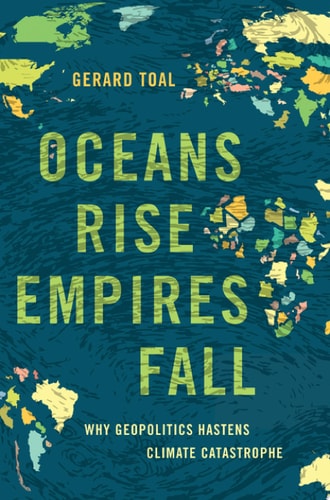
Oceans Rise, Empires Fall: Why Geopolitics Hastens Climate Catastrophe
0
0
As an Amazon Associate and affiliate partner, Menrva Books earns from qualifying purchases. Learn more
Author Description
A powerful explanation of why geopolitical competition makes implementing effective climate change policies so difficult. As the Russia-Ukraine war has shown, great-power competition drives states to prioritize fossil fuel acquisition over working toward a zero-carbon future.In the last few years, it has become abundantly clear that the effects of accelerating climate change will be catastrophic, from rising seas to more violent storms to desertification. Yet why do nation-states find it so difficult to implement transnational policies that can reduce carbon output and slow global warming? In Oceans Rise, Empires Fall, Gerard Toal identifies geopolitics as the culprit. States would prefer to reduce emissions in the abstract, but in the great global competition for geopolitical power, states always prioritize access to carbon-based fuels necessary for generating the sort of economic growth that helps them compete with rival states. Despite what we now know about the long-term impacts of climate change, geopolitical contests continue to sideline attempts to halt or slow down the process.The Ukraine conflict in particular exposes our priorities. To escape reliance on Russia's vast oil and gas reserves, states have expanded fossil fuel production that necessarily increases the amount of carbon in the atmosphere. The territorial control imperatives of great powers preclude collaborative behavior to address common challenges. Competitive territorial, resource, and technological dramas across the geopolitical chessboard currently obscure the deterioration of the planet's life support systems. In the contest between geopolitics and sustainable climate policies, the former takes precedence-especially when competition shifts to outright conflict. In this book, Toal interrogates that relationship and its stakes for the ongoing acceleration of climate change.
Menrva's Summary
THE THESIS
This book investigates why the competitive nature of global geopolitics consistently undermines the implementation of effective transnational climate change policies. Gerard Toal, a scholar of political geography, utilizes the framework of great-power competition to explain the persistent prioritization of fossil fuel acquisition over carbon reduction. By analyzing contemporary conflicts, such as the Russia-Ukraine war, the author argues that the structural imperatives of state power and economic growth create a systemic barrier to global environmental cooperation.
THE SCOPE MAP
What You Will Find
- Analysis of how great-power competition drives fossil fuel dependency.
- Examination of the Russia-Ukraine conflict as a case study for energy security versus climate goals.
- Theoretical framework linking territorial control to the acceleration of environmental degradation.
- Evaluation of the inherent conflict between national economic growth and global sustainability mandates.
THE AUTHORITY PERSPECTIVE
Experts recognize this work as a critical contribution to the intersection of political geography and environmental studies. Readers frequently note the clarity with which Toal connects abstract geopolitical theory to the tangible, ongoing climate crisis.
Page Count:
264
Publication Date:
2024-01-01
Publisher:
Oxford University Press
ISBN-10:
0197693261
ISBN-13:
9780197693261
Climate Change
International relations
Geopolitics
Community Tags
Similar Books