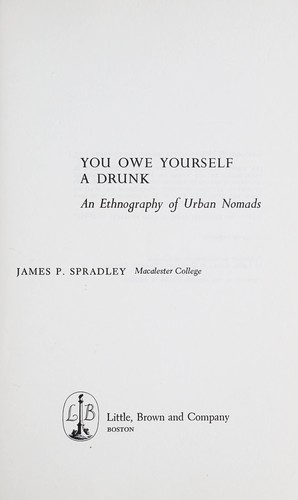
You Owe Yourself a Drunk
0
0
As an Amazon Associate and affiliate partner, Menrva Books earns from qualifying purchases. Learn more
Author Description
This book is an account of the experiences of men who are repeatedly arrested for public drunkenness. It challenges the idea that these men are simply rejects from society, who cannot organize their behavior by cultural traditions. Using the recently discovered methods of formal ethnographic analysis, the author presents this urban sub-culture as it relates to law enforcement agencies. Spradley's carefully researched portrayal of skid row men in Seattle in the late sixties documents their treatment by jails and the legal system in a time before homelessness became a recognized problem. As a result of Spradley's elegant and impassioned writing, the book became a sharp challenge to politicians, policymakers, judges, and police. This now-classic landmark study in urban ethnography stands as a shining example of the direct application of distinctly anthropological concepts and methods to address real-world problems. But more important, it represents a poignant challenge to society about our capacity to endure and accept nonconformity and social diversity.
Menrva's Summary
THE THESIS
This book investigates the societal and systemic treatment of individuals repeatedly arrested for public drunkenness. The author, James P. Spradley, a noted ethnographer, challenges conventional views of these men as societal rejects by employing formal ethnographic analysis to portray their urban sub-culture in late sixties Seattle. The study meticulously documents their interactions with jails and the legal system, predating widespread recognition of homelessness as a societal problem. Spradley's work serves as a critical examination of how society accommodates nonconformity and diversity.
THE SCOPE MAP
- An ethnographic account of men repeatedly arrested for public drunkenness.
- Analysis of an urban sub-culture and its relationship with law enforcement.
- Documentation of the treatment of individuals by jails and the legal system in the late 1960s.
- A critical examination of societal attitudes towards nonconformity and social diversity.
THE AUTHORITY PERSPECTIVE
This landmark study in urban ethnography, utilizing anthropological concepts, was a significant challenge to politicians, policymakers, judges, and police upon its release. Its careful research and Spradley's impassioned writing provided a poignant critique of societal acceptance of nonconformity and social diversity. The book is recognized for its direct application of anthropological methods to real-world problems. It remains a foundational text for understanding urban sub-cultures and the justice system's interaction with marginalized populations.
Page Count:
301
Publication Date:
1970-01-01
ISBN-10:
0316807591
Non-Fiction
True Crime
History
Urban Studies
Social Issues
Sociology
Ethnography
Law Enforcement
Community Tags
Similar Books