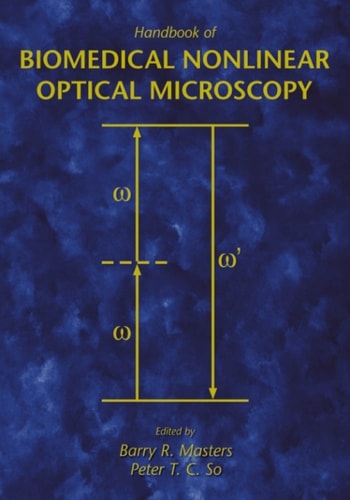
Handbook of Biomedical Nonlinear Optical Microscopy
0
0
As an Amazon Associate and affiliate partner, Menrva Books earns from qualifying purchases. Learn more
Author Description
The Handbook of Biomedical Nonlinear Optical Microscopy provides comprehensive treatment of the theories, techniques, and biomedical applications of nonlinear optics and microscopy for cell biologists, life scientists, biomedical engineers, and clinicians. The chapters are separated into basic and advanced sections, and provide both textual and graphical illustrations of all key concepts. The more basic sections are aimed at life scientists without advanced training in physics and mathematics, and tutorials are provided for the more challenging sections.The first part of the Handbook introduces the historical context of nonlinear microscopy. The second part presents the nonlinear optical theory of two- and multiphoton excited fluorescence (TPE, MPE) spectroscopy, second and third harmonic generation (SHG, THG) spectroscopy, and coherent anti-Stokes Raman spectroscopy (CARS). The third part introduces modern microscopic and spectroscopic instrumentation and techniques that are based on nonlinear optics. The fourth part provides key applications of nonlinear microscopy to the biomedical area: neurobiology, immunology, tumor biology, developmental biology, dermatology, and cellular metabolism. There are also chapters on nonlinear molecular probes, cellular damage, and nanoprocessing.
Menrva's Summary
THE THESIS
This handbook investigates the theoretical foundations, instrumentation, and practical biomedical applications of nonlinear optical microscopy. Authors Barry R. Masters and Peter T. C. So synthesize complex physical principles into a structured reference for life scientists and engineers. By bridging the gap between advanced physics and biological research, the text provides a framework for utilizing multiphoton excitation and harmonic generation in clinical and laboratory settings.
THE SCOPE MAP
What You Will Find
- Theoretical foundations of two-photon and multiphoton excited fluorescence, second and third harmonic generation, and coherent anti-Stokes Raman spectroscopy.
- Technical overviews of modern microscopic instrumentation and imaging techniques.
- Practical applications in diverse fields including neurobiology, immunology, tumor biology, and cellular metabolism.
- Tutorial-based guidance for researchers transitioning from biological backgrounds into the physics of nonlinear optics.
THE AUTHORITY PERSPECTIVE
Experts recognize this volume as a comprehensive reference for both novice and experienced researchers in the field of biomedical imaging. Readers frequently note the balance between accessible introductory material and the technical depth required for advanced instrumentation design.
Page Count:
896
Publication Date:
2008-01-01
Publisher:
Oxford University Press
ISBN-10:
0198036825
ISBN-13:
9780198036821
Science
Cell Biology
Health Services
Allied Health
Microscopy
Physics
Optics
Biomedical Engineering
Earth Sciences
Community Tags
Similar Books