Afghanistan
0
0
As an Amazon Associate and affiliate partner, Menrva Books earns from qualifying purchases. Learn more
Author Description
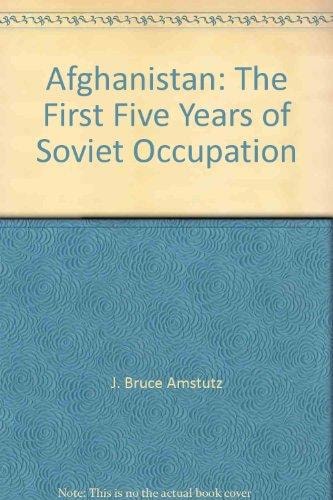
When Soviet military forces invaded Afghanistan in late 1979, the invasion was, at once, an attempt to save a tottering Marxist government and a warning to both East and West that the Brezhnev Doctrine of "necessary intervention" would be enforced. Dr. J. Bruce Amstutz, U. S. charge d’affaires in Kabul from 1977 to 1980, begins his treatment of the first five years of Soviet occupation with an historical overview of years of Russian meddling in Afghan affairs. He follows this account with a first-hand report of the 1979 invasion, then analyzes that intervention from political, military, and economic perspectives. Among the important issues Dr. Amstutz discusses are the numerous Afghan political factions - pro-Soviet and resistance - their leaders, the human rights and refugee problems, diplomatic efforts to settle the conflict, and Soviet measures to repress and indoctrinate the Afghans.
Menrva's Summary
THE THESIS
This work investigates the geopolitical motivations and consequences of the Soviet military intervention in Afghanistan during the initial five-year occupation period. Dr. J. Bruce Amstutz, who served as the U.S. charge d’affaires in Kabul during the onset of the conflict, utilizes his diplomatic background and direct observations to construct a comprehensive analysis. He examines the intersection of Marxist governance, the Brezhnev Doctrine, and the subsequent regional instability caused by external military pressure.
THE SCOPE MAP
What You Will Find
- Historical overview of Russian involvement in Afghan affairs prior to 1979
- Analysis of the 1979 invasion from political, military, and economic perspectives
- Examination of Afghan political factions, including both pro-Soviet and resistance groups
- Assessment of human rights, refugee crises, and diplomatic settlement attempts
Scope Limits
- The analysis is primarily restricted to the first five years of the Soviet occupation
- The text does not cover the full duration of the conflict or the eventual Soviet withdrawal
THE AUTHORITY PERSPECTIVE
Experts and historians frequently cite this work as a primary source for understanding the early diplomatic and political landscape of the Soviet-Afghan War. Readers often note the academic density of the prose, which provides a detailed, firsthand account of the period from a high-level diplomatic vantage point.
Page Count:
544
Publication Date:
1986-01-01
Publisher:
National Defense Univ
ISBN-10:
016001638X
ISBN-13:
9780160016387
History
Military History
International relations
Afghanistan
Soviet Union
Community Tags
Similar Books